High-thrust plans

The complex technology behind the fighter jet engines is guarded fiercely but India can draw lessons from its domestically built one
7 min read
Updated On: Jan 10 2026 | 4:30 AM IST
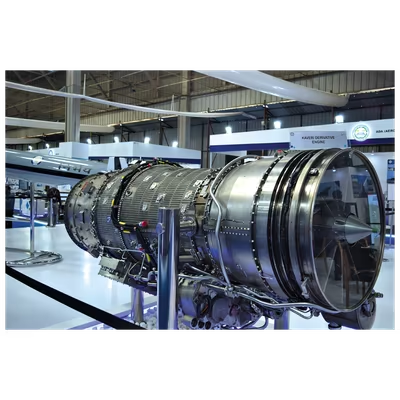
A Kaveri derivate engine at the Aero India show in Bengaluru in February 2021 (Photo: Shutterstock)

A Kaveri derivate engine at the Aero India show in Bengaluru in February 2021 (Photo: Shutterstock)

Going by public statements, you could be forgiven for thinking India is close to sealing a deal to manufacture advanced thrust jet engines to power its planned stealth combat aircraft. But wishes are not horses. 
The statements have come thick and fast. On November 28, 2025, Defence Secretary Rajesh Kumar Singh publicly said India is close to finalising a collaboration agreement with the French aerospace firm Safran, to jointly develop a 120 kilonewton (kN) thrust jet engine that will power the advanced medium combat aircraft Mark 2 (Amca Mk2).
  India, he said, would have full ownership of the intellectual property rights of the project, which was proposed by the Gas Turbine Research Establishment (a laboratory under the Defence Research and Development rganisation or DRDO), which would be  a partner.
  Two days earlier, Safran CEO Olivier Andriès had confirmed the French company’s commitment to 100 per cent transfer of technology (ToT) for a 120-140 kN engine, including critical “hot section” technologies such as precision turbine blades and 
high-temperature materials that are central to the engine’s design. 
  This was announced in the presence of Prime Minister Narendra Modi, who, in his Independence Day speech just months ago, had urged scientists, engineers, and professionals to coproduce jet engines for indigenous aircraft projects. 
  In the same month, Defence Minister Rajnath Singh officially announced the collaboration for Amca engines. Conceived as a stealth-first, fifth-generation platform, the Amca is designed to evade enemy sensors through a combination of airframe shaping, radar-absorbent materials and structures, and internal weapon carriage.  The advanced-thrust engine is central to everything the plane does, including how quickly it can exit enemy airspace and  dodge its missiles. But the plethora of announcements only reflect policy direction — India is far from signing the coveted jet engine deal with France.  
The Amca Mk2 needs the 120 kN thrust-engine because it has a higher payload, extended range, sustained supersonic performance, and a stealth-optimised flight profile, none of which can be achieved from the engines — all imports —currently being tested in India on lighter jets. 
  “We ultimately need a 120 kN high thrust engine to power the Amca to make it perform optimally and effectively,” said Kartik Bommakanti, senior fellow, strategic studies programme at the Observer Research Foundation, a think-tank.
  The Amca Mk1, expected to equip the first two Amca squadrons, will rely on the United States defence firm General Electric's (GE’s) F414 engine as an interim solution, allowing flight testing and early induction to proceed. 
  The turnaround time for developing defence technologies is never short. Bommakanti said: “Developmental cycles are protracted in India, particularly for airframes like the (light combat aircraft or LCA) Tejas. Even the JV (joint venture) agreement with Safran for the 120 kN engine is likely to be signed only by mid-2026, and by the time it is integrated into the Amca Mk2, it could be 2040 or beyond.”  
An Indian Air Force (IAF) veteran, speaking anonymously, said the Amca Mk 2 will require an engine in the 110–120 kN thrust class to sustain supersonic flight in “dry thrust”, enabling it to cruise at around Mach 1.6–1.8 without afterburners. This will bolster fuel efficiency during long-range missions while reducing the plane’s infrared signature — both essential for maintaining stealth in contested environments. 
  “If drag increases, it has to be countered with higher thrust. As the aircraft gets heavier, the engine must deliver more power,” the veteran said.
  The engine needs a very high thrust-to-weight ratio, providing enough dry thrust — core combustion without using afterburners — to overcome drag, or resistance at high speeds. This improves fuel efficiency and range, which makes it harder for enemy sensors and missiles to detect the plane — a key advantage for stealth operations. 
  “Supercruise means my engine is so good that it takes out so much thrust in dry regime that I can go supersonic… your heat signature is less, and you can still go fast.” He added that high-thrust and supercruise will help the Amca stay agile and stealthy.
  He said jet engines remain among the most complex technologies globally, requiring advanced materials, precision manufacturing, and systems-level integration under extreme operating conditions. “It is easy to make a rocket, but it is difficult to make a jet engine,” he said, noting that turbines, materials, vibration tolerance, and thermal stresses must move together seamlessly.
  The veteran pointed to the importance of India owning the intellectual property right, which would give it complete control over future modifications, upgrades, and the potential export of the Amca and subsequent platforms, including sixth-generation fighters, while reducing vulnerability to geopolitical pressures and supply disruptions.
  An industry professional, talking to the Blueprint anonymously, expressed optimism about a potential India–France engine deal, saying the project is also about creating the critical infrastructure and testing ecosystem required for high-thrust jet engines. “Developing the engine is only one part of the process. Certification, high-altitude test benches, and other facilities are equally crucial. This project can help build that entire ecosystem,” he said. 
India’s dependence on foreign aero-engine design was initially exposed over its attempts to build a LCA, designed and manufactured by Hindustan Aeronautics Limited, under the Tejas programme. The production schedule for the Tejas Mk1 and the upgraded Mk1A were disrupted by delays in the supply of GE’s F404 engines.
  With both variants relying on imported jet engines, the disruption led to a delay in the delivery of the Tejas Mk1A to the IAF, which had placed an order for 97 of these jets. 
  The DRDO-led indigenous Kaveri engine programme also struggled to meet the required thrust-to-weight ratios and remained heavier for fighter operations, despite marking some success in powering the LCA.
  Bommakanti explained the significant gaps in materials science and metallurgical engineering, which pose critical hurdles in producing high-thrust jet engines, and urged the need for finding a reliable partner. “India cannot build an engine exclusively on its own, as its experience with the Kaveri engine demonstrates,” he said. “It needs a reliable partner like France for a collaborative venture, and where ToT is possible.  Time again is critical. India's native jet development programmes have taken too long, which opens up significant gaps with our  primary adversaries.”
  Such delays could widen the technology gap with China, which is advancing its fifth-generation fighter capabilities. The industry professional cited above called for a balance between collaboration and self-reliance, saying India should leverage existing knowledge from the Kaveri programme, while collaborating in areas where it lacks expertise. “Collaboration is not a weakness; it means learning from those who have mastered the technology,” he said. 
He also underlined the long-term benefits of the project for India’s workforce and aerospace industry: “By developing this engine (for Amca Mk 2) domestically, we will train local talent and build skills. The knowledge, infrastructure, and skilled personnel will keep growing, helping India become one of the few countries capable of making high-performance fighter aircraft engines.” 
To achieve self-reliance in advanced engine development, India will need to heavily invest in research and development.  Experts argue that India should adopt a parallel model to reduce single-point failures in critical technologies for complex systems, such as the aero-engines. Bommakanti said: “India needs more competition and parallel programmes between developmental agencies in key technologies so that if one effort fails or falls short, another may deliver and work.” 
Despite facing significant challenges in manufacturing jet engines, the lessons learned from the past programmes like the Kaveri suggest that India can achieve self-reliance by forging strategic collaboration with global partners to enable a focused push to build domestic capabilities.  
Premium ContentPremium ContentSubscription ExpiredSubscription Expired

Your access to Blueprint has ended. But the story is still unfolding.

No longer a subscriber? There’s a new reason to return.

Introducing Blueprint - A magazine on defence & geopolitics

Introducing Blueprint - A magazine on defence & geopolitics

Like what you read? There’s more in every issue of Blueprint

From military strategy to global diplomacy, Blueprint offers sharp, in-depth reportage on the world’s most consequential issues.

Exclusive pricing for Business Standard digital subscribers

Choose your plan

Exclusive Pricing

Choose your plan

58% off
₹6,000

Blueprint Digital

₹2,500

annual (digital-only)

₹208/Month

70% off
₹12,000

Blueprint Complete

₹3,500

annual (digital & print)

₹291/Month

41% off
₹6,000

Blueprint Digital

₹3,500

annual (digital-only)

₹291/Month

62% off
₹12,000

Blueprint Complete

₹4,500

annual (digital & print)

₹375/Month

Here's what's included:

  • Access to the latest issue of the Blueprint digital magazine

  • Online access to all the upcoming digital magazines along with past digital archives

  • * Delivery of all the upcoming print magazines at your home or office

  • Full access to Blueprint articles online

  • Business Standard digital subscription

  • 1-year unlimited complimentary digital access to The New York Times (News, Games, Cooking, Audio, Wirecutter, The Athletic)

Written By :

Martand Mishra

Martand Mishra has started his reporting career with defence coverage. He is a graduate of the Indian Institute of Mass Communication. He enjoys reading books on defence, history and biographies.
First Published: Jan 10 2026 | 4:30 AM IST

Next Story