With the Economic Survey 2026 now tabled in Parliament, the government’s annual exercise of taking stock of the country’s economic performance has offered more than a review of growth in the past year. The document has not attempted to predict how the global economy will evolve over the next year. Instead, it has laid out a risk map, all of which assume that the old, rules-based global order has already fractured. The central premise the document makes clear is that uncertainty is no longer cyclical or temporary, but a permanent feature of the global economic landscape.
Rather than offering a single baseline, the Survey has outlined three possible worlds for 2026, where the central differentiations are the intensity of geopolitical conflict, financial stress and policy fragmentation. What unites them is the assumption that coordination is weaker, trust is lower, and economic policy is increasingly shaped by security and strategic considerations.
‘Managed disorder’ as a major global scenario in 2026
The first scenario, described as ‘managed disorder’ with a probability of around 40–45 per cent, outlines a continuation of current conditions in which global integration persists but trust weakens, volatility remains high, and governments are forced to intervene frequently to stabilise markets. This is described not as stability but as “managed disorder”, where financial stress, trade frictions and geopolitical tensions recur without triggering a systemic collapse.
It indicates that although globalisation does not end in this world, it becomes uneven, with markets remaining open but access increasingly conditional.
The emergence of a ‘disorderly multipolar breakdown’
The second scenario, also assigned a probability of 40–45 per cent, envisages a ‘disorderly multipolar breakdown’. In this world, the Survey notes that strategic rivalry may intensify, the
Russia–Ukraine conflict remains unresolved in a destabilising form, and collective security arrangements weaken. Trade becomes explicitly political, sanctions proliferate, and financial shocks are transmitted across borders with fewer institutional buffers.
In this scenario, supply chains risk being regionalised more forcefully, and capital flows increasingly move within geopolitical blocs rather than in search of efficiency.
“In this world, policy becomes more nationalised, and countries face sharper trade-offs between autonomy, growth, and stability,” the Survey noted. It also cautioned that this outcome can no longer be treated as a tail risk.
Risk of a ‘systemic shock cascade’
A third, lower-probability scenario of 10–20 per cent involves a ‘systemic shock cascade’, where financial, technological and geopolitical stresses amplify one another. The Survey warned that such an interaction could produce a sharp contraction in liquidity, a sudden weakening of capital flows and defensive economic responses across regions. It cautioned that this world could be more dangerous than 2008, not because shocks are larger, but because coordination is weaker and trust between countries is lower.
A key source of risk identified by the Survey is the recent wave of highly leveraged investment in artificial intelligence infrastructure. It cited concerns that large technology firms have shifted significant data centre spending off their balance sheets through special purpose vehicles funded by financial markets. Business models dependent on optimistic timelines, narrow customer bases and long-duration capital commitments could face stress if expectations reverse, with spillovers into broader financial markets.
India’s buffers and its core risk in a volatile world
Across all three possible outcomes for 2026, the direction of change is the same: volatility will be normalised, capital will remain cautious, trade will be politicised, and predictability eroded. The difference between the scenarios is one of degree, not direction. Hence, the Survey’s message is that the world has structurally changed.
Against this backdrop, the Survey says India is relatively better placed than many economies due to its large domestic market, less financialised growth model, strong foreign exchange reserves and a degree of strategic autonomy. However, it cautions that these strengths will not provide complete insulation.
Across all three global scenarios, India’s core risk is disruption to capital flows and pressure on the rupee. “Only the degree and the duration will vary. In a world of geopolitical turbulence, this may not be confined to a year but could be a more enduring feature,” the Survey cautioned.
It further suggested that policy credibility, predictability and administrative discipline are becoming strategic assets, and in an uncertain global environment, India will need to maximise growth while simultaneously strengthening buffers, liquidity and shock-orption capacity, effectively running a long-distance race at sprint speed.
The Economic Survey’s global outlook is not a warning about one bad year ahead, but about a permanently harsher environment in which resilience will turn out to be the price of growth.

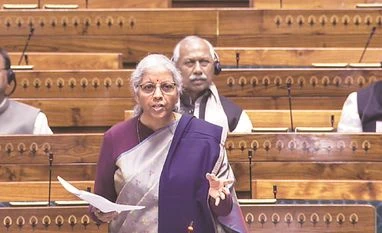 "The Economic Survey's global outlook: A world that has structurally changed")


 Connect with us on WhatsApp