Clear election verdict: Haryana for continuity; J&K needs change

The outcomes signal a pivotal moment for both regions as they face distinct challenges ahead
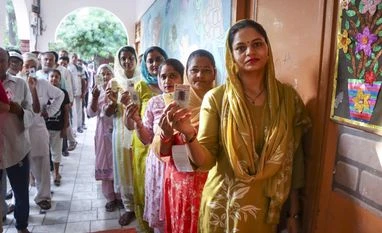
vote, election, voting, Voter, Haryana Election
(Photo: PTI)
Business Standard Editorial Comment
4 min read Last Updated : Oct 08 2024 | 10:40 PM IST
The Assembly election results for the state of Haryana and the Union Territory (UT) of Jammu & Kashmir, announced on Tuesday, were remarkable in their own ways. In Haryana, the incumbent Bharatiya Janata Party (BJP) won a record third term with significant improvement in its vote share. The BJP polled about 40 per cent of votes compared to 36.5 per cent in the 2019 Assembly elections. Although the Congress also improved its vote share from about 28 per cent in 2019 to about 39 per cent, it was not sufficient to unseat the BJP even after 10 years in power. At the end of the day, the Congress tally settled at 37, while the BJP comfortably crossed the halfway mark with 48 seats in the 90-member Assembly. It’s also worth noting that the Haryana results humbled almost all pollsters and political pundits, who had widely anticipated a clear edge for the Congress.

Politically speaking, there are at least two important takeaways from the Haryana results. First, the BJP has an extraordinary capacity to assess its position and make necessary changes. The party changed its chief minister earlier this year, and after losing five out of 10 seats in the recent Lok Sabha elections, went back to the drawing board and scripted a historic win in the Assembly election. Second, the BJP won without Prime Minister Narendra Modi campaigning much for the party. Some commentators interpreted it as a sign of weakness, but the results indicate that the party has built a formidable electoral machinery for itself.

Now the third BJP government will need to take the development process forward in the state. Over the past decades, the state has significantly shifted from agriculture to manufacturing and services, boosting per capita income. The process will need to be pushed forward. In the near term, some of the promises made by the BJP, such as monthly assistance of Rs 2,100 for women, scooties for female college students, cheaper cooking gas cylinders for poor families, along with 200,000 government jobs could put pressure on the state government finances. Although the fiscal deficit in the state is projected at 2.8 per cent of gross state domestic product (GSDP) this year, it is worth noting that capital expenditure has suffered. As a recent analysis in this newspaper showed, the capital outlay from a high of 2.4 per cent of GSDP in 2019-20 is projected to decline to 1.3 per cent this financial year. This will need to change if the state has to create capacity and maintain its growth momentum.

While the task and challenges of the next government in Haryana can be defined in relatively simple terms, things are likely to be more complicated in Jammu & Kashmir. While the pre-poll alliance of the Congress and Jammu and Kashmir National Conference is set to form the next government, it will be very different from the past. The state was converted into a UT with Article 370 of the Constitution made inoperative in 2019. The new government in the UT will not have all the powers the state government had before the constitutional change. The police, for instance, will continue to remain under the command of the central government. Now that Jammu & Kashmir will have an elected government, the Centre would do well to restore statehood as soon as possible, which will allow the new government to function like any other state government in the country and fulfil the aspirations of the electorate. At the broader political level, while all state elections are different, Tuesday’s outcome will boost the BJP’s morale for the upcoming elections in states like Maharashtra and Jharkhand.

One subscription. Two world-class reads.

Already subscribed? Log in

Subscribe to read the full story →
*Subscribe to Business Standard digital and get complimentary access to The New York Times

Smart Quarterly

₹900

3 Months

₹300/Month

SAVE 25%

Smart Essential

₹2,700

1 Year

₹225/Month

SAVE 46%
*Complimentary New York Times access for the 2nd year will be given after 12 months

Super Saver

₹3,900

2 Years

₹162/Month

Subscribe

Renews automatically, cancel anytime

Here’s what’s included in our digital subscription plans

Exclusive premium stories online

  • Over 30 premium stories daily, handpicked by our editors

Complimentary Access to The New York Times

  • News, Games, Cooking, Audio, Wirecutter & The Athletic

Business Standard Epaper

  • Digital replica of our daily newspaper — with options to read, save, and share

Curated Newsletters

  • Insights on markets, finance, politics, tech, and more delivered to your inbox

Market Analysis & Investment Insights

  • In-depth market analysis & insights with access to The Smart Investor

Archives

  • Repository of articles and publications dating back to 1997

Ad-free Reading

  • Uninterrupted reading experience with no advertisements

Seamless Access Across All Devices

  • Access Business Standard across devices — mobile, tablet, or PC, via web or app

Topics :Business Standard Editorial CommentAssembly ElectionHaryana electionJammu and Kashmir

Next Story



