Southeast Asia’s initial journey after World War II was inward-looking, with their economies tied to their former colonial masters. Through the decades, economic nationalism and self-reliance gave way to regional interdependence and integration into the global economy. Dr Acharya says the Bandung Conference in 1955 decisively shaped the trajectory of regionalism within these economies, whose collective identity as a distinct social and political entity derived from the creation of the Association of Southeast Asian Nations (Asean) in 1967. The Asean-centric view is defined as an informal, interpersonal and consensus-driven dialogue.
The author goes on to explain that the idea of Southeast Asia as a region in its own right involved rejecting Southeast Asia as a cultural appendage of China or India. Their view as active borrowers and modifiers of the two influences that came via maritime trade, not conquest or colonisation, contradicts historian R C Majumdar’s claim that India established its political authority in the region.
The Asean way recognises the cultural diversity of the members and fully respects their sovereignty as nation-states. The approach of regular dialogue and frequent interactions — often at the risk of being labelled a talk shop — has worked well for the region in resolving conflicts and containing disputes. However, the author observes that authoritarianism is an impregnable feature of the region’s political culture even as democracy has advanced in some parts.
The region continues to evoke serious human rights concerns. The Human Rights Watch criticised Asean’s callous disregard for the plight of the Rohingyas of Myanmar. This insensitivity is said to be attributed to the region's top-down rather than bottom-up governance architecture, making the dream of building genuine regional solidarity some distance away. The issue of freedom and liberty in Southeast Asia evokes uncomfortable reactions. Traditionally, Asean leaders are said to have viewed democracy as a threat to economic growth and political stability. The leading proponent of this voice was Singapore’s first Prime Minister, the late Lee Kuan Yew, who articulated the issue starkly: The exuberance of democracy, he said, leads to indiscipline and disorder that are inimical to development. Malaysia’s Mahathir Mohamad echoed this view, underlining that Asean states were right to place a high premium on political stability in their effort to strike a balance between individual rights and socio-economic obligations.
The dilemma ahead, according to the book, is whether Asean will survive the great power rivalry in the Indo-Pacific in the evolving situation of China’s growing military assertiveness, the United States’ rebalancing strategy, and the growing presence of India and Japan militarily. The author sees wisdom in Southeast Asia’s restrained approach of not choosing sides between the US and China, or hedging their bets in this geopolitical competition. He argues that China’s belligerence precludes the prospect of achieving a Sino-centric order in the region. Asean’s compelling approach of co-engagement with all major powers is a key element of its security matrix.
The author dismisses the contention that Asean’s regional centrality is inadequate in dealing with new global threats and challenges. His optimism is drawn from Asean's unrelenting commitment to economic liberalisation, inter-dependence and democracy. It also derives strength from its catalytic role as an integral part of global value chains. According to Derwin Pereira, Asean’s regional rationale is founded on its global relevance, while diminishing interdependence and integration undermines that rationale.
The aim of the Indo-Pacific concept is to create a strategic convergence. It highlights the importance of the Asean-centric values and principles. India’s approach to the Indo-Pacific should reckon with the significance of Asean-centrality. In doing so, its Act East policy should be energised with initiatives that support greater economic integration with the region. This reflective rather than research-intensive book adds useful insights and perspectives to our understanding of the long-term trends in this consequential region.
The reviewer is a serving Indian Foreign Service officer


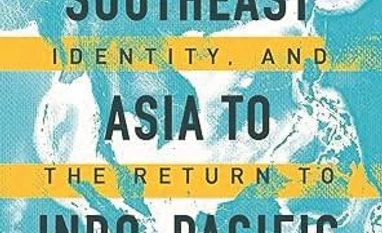 "From Southeast Asia to Indo-Pacific: Culture, Identity, and the Return to Geopolitics")