


Adaptation fails to get limelight at mitigation-focused COP28 summit
'A transition away from fossil fuels'. The decision was lauded, but what lies ahead?
 "COP28, climate change, environment")
premium
6 min read Last Updated : Dec 21 2023 | 10:17 PM IST
Oscar winner Olivia Colman recently appeared in a satirical campaign on fossil fuels in which her character, Oblivia Coalmine, says: “So while the global temperature may go up a teensy, weensy degree or two, our profits are literally soaring. And that’s all thanks to you. So to guarantee us all a warmer, snugglier future, please keep sending your pensions our way. You know the drill. Oh fracking hell!”
There is enough scientific evidence that extreme weather events induced by global warming are increasing in frequency and intensity. Despite that, there has been no reduction in production and use of fossil fuels across the globe.
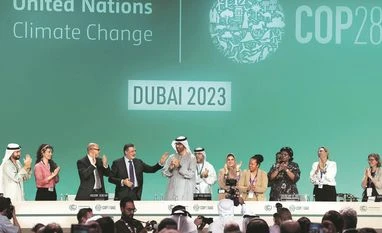
In the meantime, the oil-rich United Arab Emirates hosted the premier global climate conference, COP28, over the last fortnight. What was expected to be a climate finance COP turned out to be mitigation-focused, with the final text mentioning, for the first time, “a transition away from fossil fuels”. The decision was lauded, but what lies ahead?
A warmer future
Global climate action is divided into two parts: Mitigation (reducing carbon emissions) and adaptation (ecosystem to brace against extreme weather events). For years, the climate negotiations at COP summits have focused on mitigation, with countries committing to targets for reducing emissions. But the planet’s temperature has not been reined in.
This year is set to become the hottest in recorded human history. The United Nations Intergovernmental Panel on Climate Change (IPCC) said in its last report that under most emission scenarios, the world will breach the 1.5-degree Celsius threshold this decade. Climate experts say countries should now focus more on bracing themselves for the impact.
It was expected that the UAE will take forward the two major victories of COP26 and COP27 on adaptation: The work programme on Global Goal on Adaptation (GGA) and the historic Loss and Damage Fund (LDF).
GGA was adopted under the Paris agreement to increase awareness and funding for climate adaptation. At the Glasgow COP26, a two-year Glasgow-Sharm el-Sheikh work programme (GlaSS) on GGA was launched which calls for country-level action on adaptation. Climate action observers said COP28 did not offer much.
“Despite this progress over the past two years on establishing global adaptation targets, the discussions did not lead to an agreement on concrete, quantifiable indicators. Consequently, a new two-year programme will be initiated to devise metrics for measuring progress towards these targets,” said Harjeet Singh, head of global political strategy at Climate Action Network International.
As for the GGA, Singh noted that while developing countries did prioritise it in the negotiations, it was overshadowed by debates on phasing out fossil fuels. “A significant advancement is the establishment of global adaptation targets. The Global Stocktake text now references the adaptation finance needs of developing countries, at USD 215-387 billion annually until 2030. This provides a reference point to bridge the finance gap and intensify adaptation action,” Singh said.
A recent report by Climate Action Initiative however pegs the adaptation finance need at $1.27 trillion. Arun Krishnan, India regional programme lead, Global Innovation Lab in Climate Finance, Climate Policy Initiative, said the allocation for adaptation must increase, given the acceleration in the effects of climate change.
“It is encouraging to see the GGA recognising the need for more adaptation finance, and that concessional and grant-based financing are important tools in adaptation finance. But the intent of the GGA should be matched by global action on allocating more capital to adaptation,” Krishnan said.
Another significant step was the LDF, meant to support nations facing extreme events because of the historic pollution. The COP28 Presidency accepted the fund on the first day of the summit. But after 12 days, it was status quo. The LDF could raise barely $780 million from rich nations. It was decided to park the fund at the World Bank, but no obligation has been set for historic polluters nor is there a target year.
Senior negotiators told Business Standard that though the developed world has drawn up a list of demands and of members who will take the seat on the committee on LDF, the Global South is yet to convene a meeting to finalise its agenda.
“A few nations have expressed their desire to give legal identity to the LDF and want to host it. There are several crucial contours that need to be finalised: Name, host, executive director, rules of procedure, ethics, policy, and accountability being the top priorities,” said a negotiator from one of the Global South nations.
India’s stand and plan
India has been a strong votary of the LDF and compensation from the historic polluters. However, this year the country refrained from explicitly attacking the Global North. The line Indian negotiators maintained was to get the best deal out of the debate on fossil fuels’ phase-out.
Negotiation observers said India did not ask to be an LDF beneficiary. “The country has set a precedent through LiFE mission and net zero ambitions, but a sense of collaboration with the rest of the Global South was missing,” said a sector expert requesting anonymity.
India’s Initial Adaptation Communication submitted to the UNFCC lists close to 30 schemes and plans aimed at bolstering climate adaptation in vulnerable sectors. The report said the total adaptation-relevant expenditure in 2021-22 was ~13.35 trillion, or 5.6 per cent of the gross domestic product, a sharp rise from the ~5.06 trillion (3.7 per cent of GDP) in 2015-16.
“It is evident that India’s financial requirements for adaptation will only increase, given the vulnerabilities, increased spending on adaptation is essential for India’s economy and to protect developmental gains. International climate finance holds the key to the effective implementation of adaptation plans in India,” said the report.
Singh said the ideal position for India is to collaborate on knowledge and technology with the Global South nations. “Most state climate action plans are now prioritising adaptation, which warrants support for effective scaling up. These efforts need to be integrated into a unified strategy, focusing on locally-led planning and implementation, and backed by national and international financing,” he said.