The Comprehensive Economic and Trade Agreement (CETA) -- formally inked between India and the United Kingdom -- sidesteps any explicit reference to the UK’s CBAM, which is expected to take effect in January 2027. While New Delhi has consistently flagged concerns over the proposed levy, seeking safeguards within the agreement, London is understood to have argued that CBAM is still in its preparatory phase and therefore could not be written into the FTA text.
However, if CBAM adversely impacts Indian exports covered by the deal, the government will act to ensure that the agreed market access terms are not diluted. “If CBAM is implemented and if it negates trade benefits of India under the agreement, India will have the freedom to rebalance it. This understanding has been made in the form of note verbale,” the official said. Such a move would allow India to roll back concessions, using a built-in mechanism, should it come to that. “Note verbale” is a diplomatic communication between two governments.
India not a ‘tariff king’
CETA is also seen as part of India’s effort to shake off its image as a high-tariff nation or “tariff king” -- an image repeatedly invoked by the Donald Trump administration in the US.
The India-UK trade agreement targets a doubling of bilateral trade from $56 billion to over $100 billion by 2030. Under the deal, 99 per cent of Indian exports will enter the UK duty-free, while 90 per cent of British goods will enjoy zero tariffs in India. The agreement slashes India’s applied trade-weighted average tariff on UK imports from 15 per cent to just 3 per cent.
Although the Indian Cabinet has cleared the agreement, it still awaits ratification by the UK Parliament, a process expected to take up to a year. India plans to use that time to educate exporters on how to leverage the FTA. “Tariff is only one part of the deal,” said Commerce Secretary Sunil Barthwal. “The regulatory ecosystem between the two countries will also be improved.”
He added that the agreement includes timelines for mutual recognition arrangements, aimed at providing greater certainty to businesses in both countries. On concerns about dumping, Barthwal pointed to rules of origin and product-specific criteria embedded in the agreement as adequate safeguards.
Concerns over intellectual property chapter
The trade agreement does not dilute New Delhi's right to issue compulsory licences (CLs) and does not introduce any new preconditions for their issuance, another official said, adding that the sovereign authority to issue such licences remains entirely with the Government of India.
“The agreement’s reference to voluntary licensing simply acknowledges global best practices that encourage collaborative solutions. It does not limit or dilute India’s well-established right to issue CLs under a section of the Indian Patents Act, 1970," the official said.
This comes amid reports that India has accepted language in the intellectual property chapter of the agreement with the UK that subtly curtails its ability to issue compulsory licences, a critical tool for accessing life-saving technologies during emergencies.


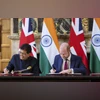 "Piyush Goyal, Piyush, Jonathan Reynold")