


Home / India News / Can Tiruppur recover from disruption wreaked by pandemic and war?
Can Tiruppur recover from disruption wreaked by pandemic and war?
Indian exporters anyway have limited pricing power, as they face competition from Bangladesh, Vietnam, Cambodia, Myanmar
 "Tiruppur, textile")
premium
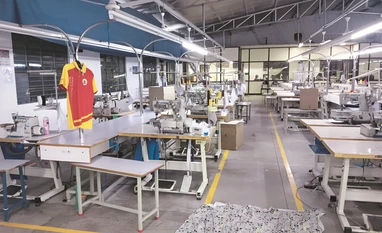
A manufacturing unit in Tiruppur wears a deserted look. With falling demand, most units in India's knitwear capital are working at 40% capacity. Some have shut down
6 min read Last Updated : Sep 26 2023 | 10:28 PM IST


A Angamuthu introduces himself in the past tense.
“Once upon a time, I was an exporter,” he says, with wistfulness on his face.
The founder of Abi Mithra Apparels, located in India’s knitwear capital of Tiruppur, in Tamil Nadu, has a rags-to-riches story.
He rose from being a textile worker to a manufacturer. Abi Mithra, which has been renamed Abi Creations, once clocked annual revenues of Rs 100 crore.
Rags-to-riches is a familiar theme with many entrepreneurs in Tiruppur. Lately, though, fortune has been flowing in reverse, thanks to the pandemic, the war in Europe, and the resulting disruption of demand and supply chains.Tiruppur is India’s largest textile cluster.
It accounts for 90 per cent of the country’s cotton knitwear exports and 55 per cent of all its knitwear exports. It has an MSME (micro, small, and medium enterprise) unit in nearly every house.
These days, the units are running at barely two-fifths their capacities. Wholesale shops are struggling to find buyers. Demand has been falling for seven consecutive months (see chart). Some exporters are on the verge of shutting down. Some already have.
Riches to rags
When Business Standard spoke to Angamuthu, he had just cleared some of his debt by selling machines in his unit for Rs 40
lakh. He had bought them for Rs 2 crore a few years ago. His workforce has shrunk from 400 to 16. One of the remaining 16 is Angamuthu himself.
For G R Senthilvel of Polo Castle, the US economy’s woes took away many clients. Senthilvel shut down his unit and was forced to sell his ancestral property to get rid of a debt of Rs 2.25 crore.
It did not help Tiruppur’s exporters that the pandemic and war came in the wake of a series of disruptions beginning 2016: Demonetisation, goods and services tax, rise in raw material and energy prices, and an uncertain economy in the United States.
“All of this put pressure on consumer spending. With the resultant rise in inventories, many players stopped imports,” says K M Subramanian, president of the Tiruppur Exporters Association (TEA).
Cotton prices have now come down, but the units here in Tiruppur are stuck with the stock bought when prices were high last year. Now they are forced to sell their finished garments at low prices linked to the new raw material prices.
Indian exporters anyway have limited pricing power, as they face competition from Bangladesh, Vietnam, Cambodia, Myanmar, Pakistan, and Sri Lanka, whose exporters charge prices 7 to 10 per cent lower than India’s.
“We face stiff competition from other exporting countries,” says Kumar Duraiswamy, chief executive officer of Eastern Global Clothing, and joint secretary, TEA.
Some of these countries enjoy the advantages of free trade agreements and, being least developed nations, favourable Customs duties in the Generalised Scheme of Preferences Plus (GSP+) category.
“Our association had 1,100 units before Covid. It has now fallen to 650, and more are shutting down. This also means a reduction in jobs,” says M Muthurathinam, president of the Tiruppur Exporters and Manufacturers Association (Teama), whose members are mostly small enterprises with turnovers less than Rs 10 crore.
Tiruppur has 20,000 units engaged in knitting, dyeing and bleaching, fabric printing, garmenting, embroidery, compacting, calendaring, and ancillary activities. They together employ 600,000 workers, of whom 200,000 to 300,000 are migrants from north India. Nearly two-thirds of the workers are semi-literate women from rural areas.
Rough estimates by Teama show about half of this workforce may be out of job already.
To assess the impact of the shutdowns and reduced utilisation of capacities, Business Standard visited the Odisha Migration Support Centre, 6 km out of Tiruppur. Established to support the youth, the support centre looked nearly deserted. Its registered migrants are estimated to have declined from 11,692 in 2019 to 5,000 now.
The ripple effect of Tiruppur’s woes is visible on spinning mills, which constitute a major part of the textile industry value chain. The Tamil Nadu Spinning Mills Association says a large number of its members have stopped production or are operating at lower a capacity due to the fallen demand, rise in interest rates, revised power tariffs, repayment of the Emergency Credit Line Guarantee Scheme loans, and unrestricted imports of yarn and fabrics from China, Bangladesh, and Vietnam, leading to a cash loss of Rs 20 to Rs 25 on every kg of yarn.
When Business Standard visited Khaderpet market, one of the largest wholesale markets in India that is within walking distance of the Tiruppur railway station, the story was no different. These days, Khaderpet, too, is about distress and closure.
“Supply-side constraints and raw material price increases led to a demand dip of 60 per cent in the last few years for wholesalers like us,” says K Praveen Kumar of Anandham Garments. He gave up a Rs 30,000 rented shop in Khaderpet and shifted to a Rs 10,000 shop, and had to reduce his staff from six to one in the last year.
Fazil B, the owner of Saman Exports, has a similar story. “Before 2017-18, we had 1,000 shops in Khaderpet market,” he says. “Now, many have shut down… Tiruppur is on a downslide. The Centre and the state should do something to hold it in place.”
On the mend?
Officials at the newly built TEA office on Appachi Nagar Main Road express confidence in demand returning from early next year. So does the administration.
Officials at the newly built TEA office on Appachi Nagar Main Road express confidence in demand returning from early next year. So does the administration.
“There is significant optimism for the upcoming winter and summer, with orders coming from the US and Europe. Some companies may have shut down due to their individual capabilities. Tiruppur continues to contribute around 55 per cent of India’s exports. The situation is not as bad as it is portrayed,” says Pavankumar G Giriyappanavar, municipal corporation commissioner of Tiruppur. He explains the fall in the number of registered migrants by saying the workforce can fluctuate according to orders and seasons.
R Senthil Kumar of Premier Agencies says the crisis may open up opportunities, as the industry is looking at alternative markets such as Russia, from which some global players have withdrawn due to sanctions.
Duraiswamy of Eastern Global Clothing says: “Tiruppur is seeing queries and orders from players such as Walmart, H&M, Tommy Hilfiger, and Target.”
Angamuthu has just received his first order of this year. “For the first time this year, I got an order from Australia last month for
$16,000. This was like a lifeline to me as I still believe that the golden days of Tiruppur will come back,” he says.This time, he is not speaking in the past tense. He is looking ahead to the future.
Topics : Coronavirus corona Russia Ukraine Conflict