The speed with which European leaders have begun engaging with the HTS regime on Syria’s economic reconstruction is, however, striking. Though HTS is still designated as a terrorist organisation, the French and German foreign ministers travelled to Damascus to meet its leader, Ahmed al Sharaa, a former ISIS and Al Qaeda chieftain. Restoring European influence in the Levant and hoping to send some of the thousands of Syrian refugees in Europe back home are only part of the explanation. The strategic goal appears to be to tap into West Asia’s vast reserves of natural gas to cut down Europe’s dependence on Russia for energy.
Former Indian Ambassador to Russia Prabhat Shukla had in a 2018 essay recalled the western aim of reducing Russia’s preponderance in the European gas market by bringing in pipelines from the Gulf, how this strategy targeted Syria which lies along the route, and how Russia’s military intervention in Syria in 2015 blocked it (Syria and the wider region: The Hydrocarbon Dimension).
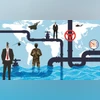
On Dec 8 last year, just two days after the HTS takeover in Damascus, the Turkish Anadolu news agency quoted Turkey’s Energy Minister, Alparslan Bayraktar, as saying the plan for a Qatar-Turkey-Europe gas pipeline transiting through Syria could now be revived. The plan, outlined in 2009, was blocked by Assad to protect Russian interests. In 2011, the anti-Assad rebellions began halting all pipeline plans, including one from Iran via Iraq. Plans stayed blocked as Russian military intervention in 2015 rescued the Assad government from collapse.
Preoccupied by its war in Ukraine, Russia was not able to bail out Assad this time around. And now Russia no longer dominates Europe’s gas supply, with many countries switching over to LNG imports (almost 50 per cent from the US). Following the sabotage of the Nord Stream pipelines and suspension of supplies via the Yamal pipeline through Poland, Russia has to compete for access to European markets mainly through LNG exports. European imports from Russia fell from 45 per cent of total gas imports in 2021 to 18 per cent in 2024, and will decline even further since pipeline supplies through Ukraine ceased at the end of 2024.
The EU, which plans to phase out gas consumption by 2040 as part of a clean energy transition, wants to stop importing gas from Russia by 2027. But it finds it is paying a very high price for the loss of relatively cheap Russian gas, which powered the industry for the last 40 years. The German economy has been driven into recession, with political consequences now seen in the collapse of the Scholz government. In 2022-23 the EU spent $700 billion to subsidise consumers for spiralling energy bills. High costs of renewable energy, which require storage and electric grid upgradations, and the replacement of piped gas by costlier LNG have contributed to making European industry uncompetitive and unable to withstand the onslaught of China’s export drives.
The EU dilemma on natural gas is exacerbated by its requirements for massive increase in power generation for planned electrification of transport and industry, and data centres for artificial intelligence, automation, etc, to propel future economic growth. (One ChatGPT query consumes 10 times as much electricity as a Google search, as the new mantra goes). A Goldman Sachs study in May 2024* estimated that the EU's power demand will increase 40 per cent by 2033, with $850 billion required for increased electricity generation. Renewable energy (and nuclear power, if accepted) could meet some of this requirement, but a reliable source of piped gas may be the optimum solution for such urgent requirements. If Russia is to be excluded, where does the EU go?
Pipeline imports from Norway, Algeria, and Azerbaijan have been stepped up, but the only countries with reserves big enough to be long-term alternatives to Russia for supplying large volumes are Iran and Qatar. Qatar is presently committed to LNG exports, but it is expanding gas production. And Doha’s past performance provides confidence to investors. Iran remains a more distant option, as it has to renew an agreement on limiting its nuclear programme to free itself of sanctions and upgrade gas production capacity. Tehran has begun talks on its nuclear programme with the European 3 (France, UK, and Germany), but Iran’s hardliners, still smarting from Israel’s blows, keep the regime’s plans enigmatic as ever.
A Qatar pipeline will need transit through Saudi Arabia. The new Syrian foreign minister’s first foreign trip was to Saudi Arabia, but whether he reassured Riyadh on its worries about the Muslim Brotherhood affiliations of some HTS leaders is not known. Qatar has only described the talk of the pipeline as “speculative”. Most importantly, the US would have to stay on board if the project has to progress. President Trump wants the US to be the energy superpower and may not want lucrative LNG exports displaced by rival suppliers. US cues could influence whether Israel chooses to pursue a campaign against Iran or reduce tensions across West Asia.
Syria itself has still to stabilise internally, and Turkey could get embroiled in conflict with the Kurds in eastern Syria. Israel has concerns about a hostile Turkey controlling Syria, and is extending its occupation of Syrian territories not very far from Damascus. Building pipelines may therefore have to await greater geopolitical certainty. India should re-examine the feasibility of undersea pipelines from the Gulf as AI and data centre requirements will soon accelerate our own electricity demand growth.
*AI is poised to drive 160 per cent increase in data centre power demand: Goldman Sachs; May 14, 2024
The author is a former foreign secretary


 "West Asian Energy")

