Such demands constrained discussions with David Cameron’s successor, Theresa May, at Number 10 Downing Street. But the political climate in Britain has turned sufficiently against migration in the interim. Just 1,800 additional professional visas have been promised. The wisdom of this restraint became visible when even an innocuous clause on double contributions to savings schemes turned into a major controversy in the UK. While there are other gaps in this agreement — for example, investments remain to be discussed — it is fair to say that this is the most broad-based agreement with a major economy and as such represents a significant shift in New Delhi’s mindset on trade.
The question is how much this shift in mindset can be applied now to other trading partners, particularly the European Union (EU). A deadline for the conclusion of the India-EU FTA has been set, with India’s Prime Minister and European Commission President Ursula von der Leyen saying that it should be concluded by the end of this year. So far, the commitments and concessions India has granted the UK have raised little or no political concerns at home. Negotiators can therefore afford to cut tariffs a little deeper and more broadly when it comes to the EU. Some of that might well be necessary, because the EU, with its size and bureaucratic structure, does require more comprehensive discussions and agreements than any other entity. But the payoffs will be equivalently large. The EU, unlike the UK, remains a major manufacturing power and it is at the centre of multiple global supply chains that Indian producers have struggled to break into. From that point of view, there is no question that an India-EU FTA might be the single-most transformative action that the government could take to enhance India’s economic prospects in the coming year.
And then there is the defensive action that New Delhi will have to fight, protecting India’s market access to, and trade surplus with, the United States (US). President Donald Trump’s second deadline for high tariffs on imports into the US is fast approaching, and several countries, such as Japan, have already announced deals with him. None of these deals is particularly favourable to the countries that have signed them with the US. The UK, which exports less to the US than it imports, nevertheless now faces a 10 per cent baseline tariff. Japan faces 15 per cent, and has had to drop protections against sub-standard US rice and, in return for that privilege, it has promised to invest $550 billion in the US. India will also have to make similar concessions. The question is at what level India and the US will settle.


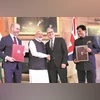 "Narendra Modi, Keir Starmer")