Monday, January 05, 2026 | 02:40 AM ISTहिंदी में पढें
Business Standard
Notification Icon
userprofile IconSearch

Donald Trump's 'reciprocal tariffs' agenda raises global economic fears

From the thickets of alternative facts, Maga (Make America Great Again) tropes, inflated claims, and theatrical asides involving invitees in the gallery, two signals emerged from Mr Trump's address
Donald Trump, Trump
premium

Photo: X@POTUS

Business Standard Editorial Comment Mumbai

Listen to This Article

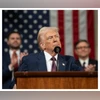
Donald Trump’s first address to a joint session of Congress since he won his second term as United States President barely differed in tone and content from his campaign rallies or inaugural address at the same venue six weeks ago. He took the podium against the background of a tanking stock market owing to the trade wars he has unleashed and the second-lowest job approval rating of 45 per cent among Presidents at this point in their term, according to Gallup. The lowest rating was scored by Mr Trump himself at 40 per cent in 2017. Nevertheless, he delivered a triumphal speech that was long — literally, at more than 90 minutes, the longest such address in modern American history — on rhetoric and demagoguery and short on accuracy. From the thickets of alternative facts, Maga (Make America Great Again) tropes, inflated claims, and theatrical asides involving invitees in the gallery, two signals emerged from Mr Trump’s address.
 
The most potent is that he does not plan to back away from his tariff wars. On Tuesday, he made good his threat to impose 25 per cent tariffs on Mexico and Canada and added a 10 per cent tariff to Chinese imports (taking total tariffs to 20 per cent) — a move The Wall Street Journal, a pro-Trump outfit, described as the “dumbest tariff plunge”. In his address to Congress, he declared April 2 as the start date for his campaign of reciprocal tariffs. He described this tit-for-tat trade agenda thus: “Whatever they tax us, we will tax them. If they do non-monetary tariffs to keep us out of their market, then we will do non-monetary barriers to keep them out of our market.” At a time when Commerce Minister Piyush Goyal was in Washington to discuss a bilateral trade deal, Mr Trump called out India for charging 100 per cent tax on automobiles, ignoring the fact that this had been lowered in the Union Budget to 30 per cent. Mr Trump’s penchant for unpredictability suggests that India may need to accelerate the process of concluding its trade agreement with the European Union (positive meetings over the weekend point to a prime opportunity), seek to integrate with the booming markets of Southeast Asia faster, and rapidly address its tariff regime.
 
The other consequential indicator in the address was a hint of forward movement on Ukraine-Russia peace talks, despite exaggerated estimates of US assistance to Ukraine. After the disaster of the public Oval Office altercation with Volodymyr Zelenskyy, the US President read a conciliatory letter from his Ukrainian counterpart, suggesting that the peace-for-minerals deal could be back on track. As an exercise in rallying the nation, the speech could not have been called a success. The raucous applause from the Republican side of the aisle and emptying seats on the Democrat side highlighted the deeply divisive nature of American politics. With China, Canada and Mexico retaliating, there is no visibility on the end-game in the trade wars, though Yale’s Budget Lab predicts a 1-1.2 per cent rise in US price levels. The Americans may start counting the cost of their decision at the November elections soon, but the speech, once traditionally known as the State of the Union address, underlines that the portents for the global economy are worse than what most analysts had reckoned.
