
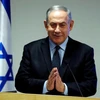

Who is Benjamin Netanyahu?
Benjamin Netanyahu is a former Prime Minister of Israel who served for a total of 15 years in office. He was the prime minister from 1996 to 1999 and then re-elected from 2009 to 2021 after Naftali Bennett ousted him from his reign. He presently serves as the chairman of the National Liberal Movement (Likud party) and Leader of the Opposition.
Benjamin Netanyahu: Before PM Office
Born in Tel Aviv and raised in Jerusalem, Netanyahu joined Israel defense after high school in 1967. He trained as a combat soldier and served for five years in the special forces unit.
Following this, he went onto study architecture at the Massachusetts Institute of Technology (MIT) in the US. Post his Master's, he returned to Israel and ran the Jonathan Netanyahu Anti-Terror Institute, a non-governmental organisation devoted to the study of terrorism. He was director of marketing for Rim Industries in Jerusalem for the next two years in 1982. From 1984 till 1988, Netanyahu served as the Israeli ambassador to the United Nations.
Benjamin Netanyahu joins politics
Ahead of the 1988 legislative election, Netanyahu joined the Likud party in Israel. He was elected as a member of Parliament (Knesset) and was appointed as a deputy of foreign minister. During the Gulf War, Netanyahu became a principal spokesman for Israel and during the Madrid Conference, he was a member of the Israeli delegation headed by PM Yitzhak Shamir. He was appointed as Deputy Minister in the Israeli Prime Minister's Office after the conference.
Netanyahu's tenure as PM
In 1993, the Likud party held an election to select its leader, in which Netanyahu emerged victorious. He was the PM candidate in the 1996 Israeli legislative election and won the polls, becoming the youngest person in the country's history to hold that position.
Following this, Netanyahu went onto serve four more terms, the last being in 2020.
During his first term as PM, Netanyahu raised questions surrounding the Oslo Accords after a series of Hamas bombings. He was against concessions given to Palestinians as that only gave encouragement to extremist elements, without receiving any tangible gestures in return.
In 1996, he met Palestinian President Arafat for the first time and both agreed to work for the security at both sides. The talks ended with the signing of the Hebron Protocol in 1997, leading to the redeployment of Israeli forces in Hebron. The lack of progress led to new negotiations which resulted in the Wye River Memorandum in 1998. Signed by Netanyahu and Arafat, it emphasised no withdrawal from the Golan Heights, no discussion of the case of Jerusalem, no negotiations under any preconditions.
The PM also began taking steps towards a free-market economy. Under his leadership, the Likud-led government began selling its shares in banks and major state-run companies. He also eased strict foreign exchange controls, enabling Israelis to take an unrestricted amount of money out of the country and invest freely in other countries.
Netanyahu back in the Opposition
In 1999, Netanyahu was defeated in the election for Prime Minister, after which he retired temporarily from politics. In 2002, Prime Minister Ariel Sharon appointed Netanyahu as Foreign Minister.
As a finance minister, he undertook an economic plan to restore the economy from its low point during the Second Intifada, claiming that a bloated public sector and excessive regulations were responsible for poor economic growth.
Netanyahu's second inning as PM
During his second term, he endorsed a "Demilitarised Palestinian State" following US President Barack Obama's speech delegitimizing Israeli settlement in the Palestinian state. PM Netanyahu stated that he would accept such a state if Jerusalem stays the capital of Israel, the Palestinians would have no army, and that they would give up their demand for the right of return. The cabinet came up with the establishment of a working national unity government, and a consensus for a "two-state solution".
In 2013, he called for early elections and won the polls again. During this time, he continued his policy of economic liberalisation and approved the Business Concentration Law, which intended to open Israel's highly concentrated economy to competition.
In 2014, he showed deep concerns when Hamas and the Palestinian Authority formed a unity government. He blamed Hamas for the murder of three Israeli teenagers and launched a massive search and arrest operation on the West Bank.
His fourth term started in 2015 and in 2020, Netanyahu was sworn in for a fifth term as prime minister.
Netanyahu's government approved a two-year budget in 2015 that would see agricultural reforms and lowering of import duties.
In 2017, Netanyahu called for the death penalty to be imposed on the perpetrator of the 2017 Halamish stabbing attack, where 52 of 120 members of the Israeli parliament voted in favour.
In 2018, he accused Iran of not holding up its end of the nuclear deal, following which, the latter denounced Netanyahu's presentation as "propaganda".
End of Term
In 2020, extensive demonstrations broke out in the country against the backdrop of the coronavirus pandemic and Netanyahu's criminal trial.
After tensions escalated in May 2021, as Hamas fired rockets on Israel from Gaza, Netanyahu initiated the Operation Guardian of the Walls. Post-operation, Yamina leader Naftali Bennett announced that along with Leader of the Opposition Yair Lapid, they had formed a coalition rotation government, removing Netanyahu from his leadership on June 13, 2021.