Bharti Kher is a rare artist pushing boundaries in her creative quest

Kher is a researcher, a mathematician and an anthropologist
Bharti Kher
Bharti Kher. (Photo: Dalip Kumar)
Avantika Bhuyan
Last Updated : Aug 25 2017 | 10:24 PM IST
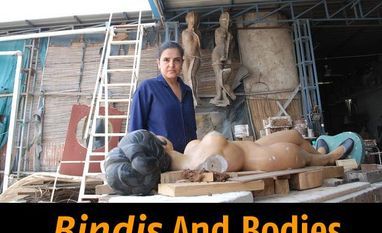
Dressed in overalls, Bharti Kher is in work mode at her studio in Gurugram, testing materials and engaging in rigorous research. The studio, which carries a sense of organised chaos, is populated with her famous sari sculptures, a set of new works and a plethora of books.

The past year has been a busy one, with Kher showing the acclaimed Six Women — a series of life-sized, sitting sculptures of six actual women, sex workers from Sonagachi, cast in plaster — at the 20th Biennale of Sydney. This was followed by her first major retrospective in North America, BHARTI KHER Matter, at the Vancouver Art Gallery, which incorporated elements of painting, photography and sculpture — hallmarks of Kher’s practice over the past two decades. This year also brought with it an opportunity to be an artist-in-residence, along with her husband, Subodh Gupta, at the Rashtrapati Bhavan.

I ask her about the experience, and if the lush environs fuelled her imagination? “I think Subodh was a lot more art-productive,” says 48-year-old Kher who spent most of her time walking around or ensconced within the library, reading voraciously. “There is a book on 100 years of Rashtrapati Bhavan that has some amazing trivia on the dignitaries and stars that visited the place,” she says. “It has extraordinary images from [former] Russian president [Leonid] Brezhnev’s visits, when he brought along a whole entourage, including chefs and endless supplies of food and vodka, and also a huge press corps that set itself up outside Palam, live streaming his visit.”

Kher’s mind seems to act as a sponge when it comes to soaking in trivia. “I love miscellanea and matter,” she says. Research is integral to her inquiry. “Say, I decide to work with mirrors, then I want to know when and how they were first made and by whom.” This idea got her interested in the late 17th century, which is when mercury was mixed the very first time. She tells me that back then only two companies used to make mirrors, making it one of the most expensive commodities of that period. “When I do research, I come to conclusions about my own work. This inquiry is a journey in itself,” says Kher. 

For instance, her research on triangulation for her work, three decimal points. of a minute. of a second. of a degree, which she showcased at the Kochi-Muziris Biennale in 2014, took her to the house of Welsh surveyor and geographer George Everest in Mussoorie. 
Installations from BHARTI KHER: Matter.  (Photography: Maegan Hill-Carroll; Courtesy: Bharti Kher)
Today, Kher is counted as one of the top Indian contemporary artists, globally. According to the Indian Art Market Report 2015 by ArtTactic, she topped both the short term and the long term confidence rankings and was hailed as one of the most visible Indian contemporary artists in the world. And, the South Asian Market Report 2017 states that in spite of the contemporary segment accounting for less than 5 per cent of the South Asian-dedicated auction sales in 2016, a few contemporary artists such as the husband-wife duo of Kher and Gupta have seen significant works sold in non-South Asian sales in New York, Paris, London and Hong Kong. In 2016, their auction sales accounted for $1.3 million. 

Kher first met Gupta while travelling through India immediately after graduating from Newcastle Polytechnic, UK. She didn’t speak Hindi very well, and culturally the country was a huge shock to her. Over time, the two fell in love and got married. 

With both being leading contemporary artists, do they compete with each other? “We do compete (healthy or unhealthy),” she told CNN.com in a 2013 interview. “I think the crux of our relationship is art because this is something we are both extremely passionate about.” 

As one looks back at her practice, it is the bindi works, hybrid sculptures and recent cabinet pieces that emerge as landmarks. According to Diana Freundl, associate curator (Asian art), Vancouver Art Gallery, these, in many ways, emerge as a thread through all her works. To some, her bindi represents the outer skin, challenging conventional notions of beauty. To others, it is a sort of a camouflage, which, when scratched, reveals the inner self. 

The reading of her work changes for everyone. “For instance, our female visitors responded to Six Women differently from the male visitors,” says Freundl. According to her, Kher’s work is also informed by her own experience of growing up as a British-born Indian. “But she has been in India for a number of years, perhaps longer than her ‘native’ country,” Freundl adds. “I am sure her way of looking and perceiving has changed enormously over the years.”

Kher is no longer interested in creating single layers of meaning. She is seeking neither answers nor the truth. “I am asking questions of myself. I am looking for the magic of that great work that never has to speak, an alchemy of material mixed with an image that is frozen in time, the work that makes you weep, which talks of everything — love and pain,” she says. 

The bindi has acted like a mark of continuity through her work. It started as a leitmotif, but has now become a language that she has invented and is free to use whichever way she wants.
Installations from BHARTI KHER: Matter. (Photography: Maegan Hill-Carroll; Courtesy: Bharti Kher)
Another thread that can be seen through her work is the idea of the “body”. One can see that in Hybrids — amorphous creatures who are part-women, part animal — and also in Six Women. “The works were not specifically dealing with body casts. They were dealing with what was not or what was perhaps suggested through the casting of the skin through the memory of this tactility of plaster and how it impregnates the skin and somehow takes the essence through the pores,” says Kher. 

I ask her if her subjects ever tell her what they feel when they are encased in plaster. “I have no idea what they think when their heads are encased in plaster. I would imagine only suffocation,” she says. “But all my models over the years say otherwise. The head is truly the most challenging part. It is always the last part. It involves complete trust and calm in the model.”

Kher has been called several things in the past — a feminist, a narrator of mythologies and a quasi-anthropologist. Which of these does she identify with most? “I see myself as all of these. If not an artist, I would have been an anthropologist, a deep-sea driver or in public service. I could have tried to be a neurosurgeon or a mathematician — there is magic in numbers,” says Kher. “You want to be things that allow you to compensate for and challenge your strengths and weaknesses. When I 
am in the studio, I am all of those things.”

One subscription. Two world-class reads.

Already subscribed? Log in

Subscribe to read the full story →
*Subscribe to Business Standard digital and get complimentary access to The New York Times

Smart Quarterly

₹900

3 Months

₹300/Month

SAVE 25%

Smart Essential

₹2,700

1 Year

₹225/Month

SAVE 46%
*Complimentary New York Times access for the 2nd year will be given after 12 months

Super Saver

₹3,900

2 Years

₹162/Month

Subscribe

Renews automatically, cancel anytime

Here’s what’s included in our digital subscription plans

Exclusive premium stories online

  • Over 30 premium stories daily, handpicked by our editors

Complimentary Access to The New York Times

  • News, Games, Cooking, Audio, Wirecutter & The Athletic

Business Standard Epaper

  • Digital replica of our daily newspaper — with options to read, save, and share

Curated Newsletters

  • Insights on markets, finance, politics, tech, and more delivered to your inbox

Market Analysis & Investment Insights

  • In-depth market analysis & insights with access to The Smart Investor

Archives

  • Repository of articles and publications dating back to 1997

Ad-free Reading

  • Uninterrupted reading experience with no advertisements

Seamless Access Across All Devices

  • Access Business Standard across devices — mobile, tablet, or PC, via web or app

Next Story



