Damn lies and the truth

Book review of How to Make the World Add Up: Ten Rules for Thinking Differently About Numbers
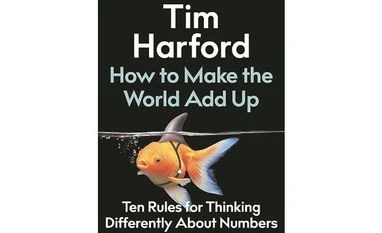
Book cover
Book cover of How to Make the World Add Up: Ten Rules for Thinking Differently About Numbers
Prosenjit Datta
5 min read Last Updated : Dec 11 2020 | 12:00 AM IST
India gets a brief mention on page 207 of Tim Harford’s new book where he mentions how Prime Minister Narendra Modi’s government quietly stopped publishing unemployment data in 2019. Thankfully, the other controversies regarding the government’s official statistics — the gross domestic product back calculation brouhaha or the junking of the 2017-18 Consumer Spending Survey data — are not discussed.

How to Make the World Add Up is both a defence of statistics as well as a guide on how to understand them, what to look out for, and the things that can go wrong in both designing as well as interpreting data. Though the cover talks of 10 rules, Mr Harford actually gives 11 — the last one is termed a special rule telling you to keep an open mind.

Mr Harford, a prolific writer, number nerd and senior columnist at the Financial Times,  loves statistics — and also understands the many ways it can be misused. It is the misuse of statistics, and the bad rap it is getting, that spurred him to write the book.

The introduction is largely devoted to the 1954 non-fiction best seller How to Lie With Statistics that was written by a freelance American journalist  Darrell Huff. It dealt with how statistics could be used to prove almost anything. It left people sceptical about the whole use of statistics, and gave rise to follow-up books on the same lines.

But in the same year that Huff published his best seller, two British researchers, Richard Doll and Austin Bradford Hill, produced one of the first convincing studies linking cigarette smoking with cancer, Mr Harford points out. The cigarette industry tried to rubbish their work and conclusions — and used Huff’s work to cast doubt. But the painstaking survey and the evidence were too strong — and it led to further studies that finally convinced the medical profession about the dangers of smoking.

So while Huff tried to make statistics look like some kind of smoke and mirrors trick, good statistics are actually magic, says Mr Harford. Having said that, he goes on to expand on his points — and also give simple pointers (or rules) on how to distinguish between good statistics and bad ones.

Mr Harford peppers his chapters with interesting stories and anecdotes — from social as well as psychological research studies — and also medicine, art, history and economics to make his points. He talks of bias and how that can both colour the way you interpret results of a study as well as the way you as a researcher can design the study.

Statisticians and researchers collecting data have invariably had to face multiple obstacles — and sometimes grave danger. There is a whole chapter devoted to the perils of bringing out statistics that are unflattering to the government. In India, statistics that do not support the government’s tale have merely been buried. In some countries, the chief statistician has been executed or even had to face prosecution for not lying about data.

How to Make the World Add Up: Ten Rules for Thinking Differently About Numbers
Author:  Tim Harford
Publisher: Hachette
Pages: 338; Price: Rs 699

He looks at big data, algorithms, and where they come up short and also where they are can be as reliable as humans. He looks at why painstaking collection of statistics that are then analysed by experts can be far superior to computer analysis of real time data in order to find patterns.

The best chapters are those that look at how to design studies better. The author examines many things that are well known but often get overlooked while doing surveys. How you frame a question, for example, has a huge bearing on the results you get. Thus, by just framing what constitutes unemployment you can end up with completely different estimates. In one example, he shows how the way hospitals recorded the death of a child completely changed the picture of infant mortality between two regions in the UK.

The medical field especially throws up rich examples in almost every rule. Mr Harford points out that Florence Nightingale used data to drastically reduce mortality in hospitals even though the doctors were initially unconvinced. (It had to do with hygiene — a subject that Atul Gawande has also visited in some of his books). Not every chapter is equally interesting. I found the first few rather tedious, in fact, but the book picked up pace in the latter half. But each rule in the book is important, though some are more obvious than others.

The book is replete with all sorts of stories about striking but false surveys. The study claiming that more choice makes a consumer buy less was later found to be unreliable by researchers who tried to replicate it. Another chapter looks at how many studies that were peer reviewed, accepted and created sensations could not be replicated by others — and were proven to be either doctored or simply false. He talks of researchers cherry picking results that suit their foregone conclusions.

For any business journalist who uses statistics routinely, this is a must-buy book. Even for laymen, it is useful because it teaches them to be more nuanced while looking at startling numbers.


One subscription. Two world-class reads.

Already subscribed? Log in

Subscribe to read the full story →
*Subscribe to Business Standard digital and get complimentary access to The New York Times

Smart Quarterly

₹900

3 Months

₹300/Month

SAVE 25%

Smart Essential

₹2,700

1 Year

₹225/Month

SAVE 46%
*Complimentary New York Times access for the 2nd year will be given after 12 months

Super Saver

₹3,900

2 Years

₹162/Month

Subscribe

Renews automatically, cancel anytime

Here’s what’s included in our digital subscription plans

Exclusive premium stories online

  • Over 30 premium stories daily, handpicked by our editors

Complimentary Access to The New York Times

  • News, Games, Cooking, Audio, Wirecutter & The Athletic

Business Standard Epaper

  • Digital replica of our daily newspaper — with options to read, save, and share

Curated Newsletters

  • Insights on markets, finance, politics, tech, and more delivered to your inbox

Market Analysis & Investment Insights

  • In-depth market analysis & insights with access to The Smart Investor

Archives

  • Repository of articles and publications dating back to 1997

Ad-free Reading

  • Uninterrupted reading experience with no advertisements

Seamless Access Across All Devices

  • Access Business Standard across devices — mobile, tablet, or PC, via web or app

Topics :BOOK REVIEWeconomyStatisticsNarendra Modi

Next Story



