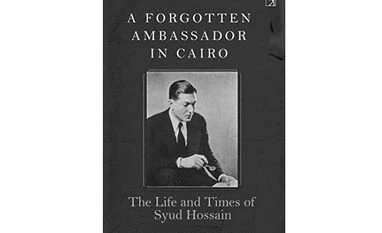
If you grew up learning about all the luminaries who contributed to India’s freedom struggle but never heard of a man called Syud Hossain (1888-1949), don’t be harsh on yourself. You can blame Motilal Nehru and Mohandas Karamchand Gandhi instead. Does that sound bizarre? Read N S Vinodh’s book A Forgotten Ambassador in Cairo: The Life and Times of Syud Hossain (2021) to uncover the colourful and murky details.
This book has been written by a Bangalorean who works in corporate real estate and dabbles in history as a passion project. He writes, “Born of an elite pedigree, dashingly handsome, erudite, articulate, a mesmerizing orator, an outstanding writer, and a secular patriot but with an equally prominent wild side, Syud Hossain’s noteworthy accomplishments went unrecognized perhaps because he had fallen foul of a powerful family.”
What did he do to warrant their ire? Hossain, who took charge as editor of Nehru’s nationalist newspaper The Independent in 1919, fell in love with his boss’s daughter Sarup. If Mr Vinodh’s account is to be believed, this transgression sealed Hossain’s fate in India despite the fact that the newspaper had “played a stellar role in disseminating the draconian provisions and disastrous consequences of the Rowlatt Act to the public, despite being subjected by the government to censorship, intimidation, and threats of physical harm.”
When Hossain moved to Allahabad to work for Motlilal Nehru, he lived with the boss’s family in his palatial house Anand Bhawan. The empty stables on that property housed the newspaper’s office. Nehru’s daughter was 19; Hossain was 12 years older. Mr Vinodh writes, “Western-educated, handsome and debonair young men were not all that common in Allahabad, and very soon Cupid’s presence was apparent in the vast tranquil gardens of Anand Bhawan.”
If you thought that the high-profile protagonists in India’s anti-colonial history were occupied with nothing other than prabhat pheris, civil disobedience and spinning khadi, this book will be an eye-opener. The author might come across as a person with a febrile imagination but his work is grounded in archival research. This is evident from the copious notes he has included in the book for people keen to explore the source material.
Title of the book: A Forgotten Ambassador in Cairo
Publisher: Simon & Schuster India
Pages: 480; Price: Rs 799
Mr Vinodh writes, “One source mentions that they were married in a hastily convened ceremony according to Muslim custom. When presented with this fait accompli, Motilal was infuriated. That such a thing could happen in his house under his family’s watchful gaze horrified him. Jawaharlal too was no less angry with his sister. The incident became a conversation filler from the poorest of mohallas to the most opulent of manzils in Allahabad for years to come.”
Nehru enlisted Gandhi’s help in convincing the couple to annul their marriage. Hossain was reprimanded for his impetuousness. Sarup was sent off to the Sabarmati Ashram, which she found exceedingly drab and austere. The author pieces together recollections from Sarup’s memoirs and her no-holds-barred letter to Sarojini Naidu’s daughter Padmaja, who was a confidante during that painful time.
In this letter, Sarup spills the beans about Gandhi’s reaction. He told her, “How could you regard Syud in any other light but that of a brother — what right had you to allow yourself, even for a minute, to look with love at a Mussulman…Out of nearly 20 crores of Hindus couldn’t you find a single one who came up to your ideals — but you must needs pass them all over and throw yourself into the arms of a Mohammedan.” The antipathy towards inter-faith marriage is much older than the current campaign against so-called “love jihad”.
The stark difference between Gandhi and B R Ambedkar’s positions on caste is apparent from this episode but Mr Vinodh does not engage in that analysis. However, he mentions that Sarup was engaged to “Ranjit Pandit, a Maharashtrian Saraswat Brahmin” with “the express blessings of Gandhi.” He also comments on how Nehru was “a conservative orthodox Hindu at heart” despite his adoption of “western ways in his sartorial and dining styles.”
Those who hail Gandhi as a proponent of Hindu-Muslim unity might find this shocking but Mr Vinodh quotes from his article for Young India in 1920. Gandhi writes, “It would seriously interfere with the growing unity between Hindus and Mahomedans if, for example, Mahomedan youths consider it lawful to court Hindu girls…I hold it to be utterly impossible for Hindus and Mahomedans to intermarry and yet retain intact each other’s religion.”
Gandhi urged Hossain to work for India’s freedom by drumming up support in the United States. Hossain respected him, so he agreed. He advocated for the rights of Indian immigrants in the US, and also became India’s first ambassador to Egypt. Sarup took on the name Vijayalakshmi Pandit after her second marriage. Hossain had other relationships but he remained a bachelor.
After he died, a tomb was built in Cairo in his memory. The author expresses surprise that a diplomat should be commemorated with an elaborate mausoleum, but he does not pursue this line of enquiry, which is a pity. Pandit, who became the first female president of the United Nations General Assembly, would stop periodically in Cairo to “spend a few hours at the tomb.” Hossain may have been forgotten by others but she remembered him.

 "'Love jihad' in the time of nationalism?")











