The first people

This book by Nidhi Dugar Kundalia is about the "first people" or some of the aborigines of India she met and interviewed in the course of researching the book
book review
The book chronicles six tribal stories and the members of certain tribes across the country she interviewed and tracked in their homes and habitat
Sudha G Tilak
4 min read Last Updated : Apr 29 2020 | 11:38 PM IST
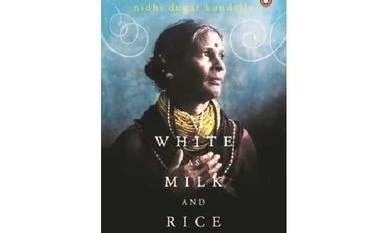
It’s not wrong to judge a book by the cover. Especially this one. The cover girl of White as Milk and Rice,  photographed by Madhumita Nandi, is a middle-aged Halakki tribal woman, her tied back in a knot, ears pierced and bejewelled and her shoulders and neck covered in layers of bead necklaces. Her hand is placed on her chest in a gesture of dignity and self-preservation. Her face, streaked with proud lines is lit up and the only odd element is the felt   bindi  stuck on her forehead. 

This book by Nidhi Dugar Kundalia is about the “first people” or some of the aborigines of India she met and interviewed in the course of researching the book. The book chronicles six tribal stories and the members of certain tribes across the country she interviewed and tracked in their homes and habitat. 

This detailed investigation and enquiry takes the author to some of India’s most isolated tribes, such as the Marias of Bastar, the Kanjars of Chambal, Konyaks and Khasis of Nagaland and Shillong respectively 
and the Halakkis and Kurumbas of south India. 

Her descriptions of tribal villages, their songs and customs, from ant chutneys, rice beer and sacrificial pigs for feasts, innate knowledge of the earth, flowers and herbs —from the orchid to the intoxicating mahua flower— opium and images of  surta or tobacco-smoking chiefs resting at dusk in tribal hamlets all bring alive the sights and smells of tribal life. 

White as Milk and Rice — Stories of India’s Isolated Tribes

Author: Nidhi Dugar Kundalia

Publisher: Penguin

Price: Rs 399


That India has been given short shrift as the country races towards modernisation and urbanisation is well recognised. But the marginalisation began long before that. The harshest was when the colonialists turned many of the original people of India into “denotified tribes” or vimukta jati  leading to persecution and criminalisation of many tribes. Neglect and apathy towards tribal people did not end after India became independent, however. 

Part of the problem was that the popular media, even with the best of intentions, often objectified, exoticised, or sentimentalised the portrayals of tribals in photographs or in movies. There were exceptions, such as Vijay Tendulkar’s play Kamla, which shone a light on the irony of an investigative journalist who “purchased” a Bhil tribal woman to display her in a press conference. And the iconic Satyajit Ray’s Aranyer Din Ratri  on the biting contrasts between the indigenous peoples and a group of city slickers with Simi Garewal playing an exotic Santhal tribal woman. Shyam Benegal’s Close to Nature  was a hard-eyed documentary on the Bastar tribes.

Ms Kundalia’s book is refreshing because it offers an inside perspective about some of the tribes of India. She acknowledges the paucity of their stories being told in their own voices and the centuries of distrust between the outsider as interviewer seeking their many truths. She also recognises the niggling contradictions of tribal practices that are recorded in mainstream society as part of othering and the attempts at modernisation or development by displacement or conversion. Similarly, the zeal for urbanisation that has eroded tribal culture, livelihood and environment or confiscated their resources  are held up as problems inflicted upon tribals by mainstream society.

Ms Kundalia also writes the vulnerability of India’s many tribes brutally caught in the crossfire of conflicts between rebels in the forests and the government forces and the zeal to “civilise” them within society or organised religion. She cites the example of a couple of Khasi sisters who refused to convert in the northeast or the Kurumba boy who rejected education to taking up arms in south India. Ms Kundalia does not ignore some of the more discomfiting aspects of some tribal customs, practises and laws and writes of them as contradictions that require resolutions with sensitivity. 

The book’s title owes to this conflicting mix of judgement of the tribal population by urban, mainstream society. The Kurumba tribe of the Nilgiris in south India added the prefix “milk” in the local language to their tribe’s name to imply purity of intentions (as white as milk) because they were deprived of education and employment owing to certain practices they followed. The Halakkis of North Karnataka grow rice, which is white and denotes honourable intentions. Thus,  White as Milk and Rice.

If reading anthropological treatises by Levis Strauss or a Verrier Elwin is daunting for you, gentle reader, Ms Kundalia’s warm accounts of the forest peoples, mainly women and some men, and their narratives from the margins and the rough realities of their lives makes this book a worthy introduction to some of India’s original inhabitants.

One subscription. Two world-class reads.

Already subscribed? Log in

Subscribe to read the full story →
*Subscribe to Business Standard digital and get complimentary access to The New York Times

Smart Quarterly

₹900

3 Months

₹300/Month

SAVE 25%

Smart Essential

₹2,700

1 Year

₹225/Month

SAVE 46%
*Complimentary New York Times access for the 2nd year will be given after 12 months

Super Saver

₹3,900

2 Years

₹162/Month

Subscribe

Renews automatically, cancel anytime

Here’s what’s included in our digital subscription plans

Exclusive premium stories online

  • Over 30 premium stories daily, handpicked by our editors

Complimentary Access to The New York Times

  • News, Games, Cooking, Audio, Wirecutter & The Athletic

Business Standard Epaper

  • Digital replica of our daily newspaper — with options to read, save, and share

Curated Newsletters

  • Insights on markets, finance, politics, tech, and more delivered to your inbox

Market Analysis & Investment Insights

  • In-depth market analysis & insights with access to The Smart Investor

Archives

  • Repository of articles and publications dating back to 1997

Ad-free Reading

  • Uninterrupted reading experience with no advertisements

Seamless Access Across All Devices

  • Access Business Standard across devices — mobile, tablet, or PC, via web or app

Topics :BOOK REVIEW

Next Story



