
GST impact: Cement growth in east India down from earlier projection
NGT ban on sand mining in Bihar has been a dampener too
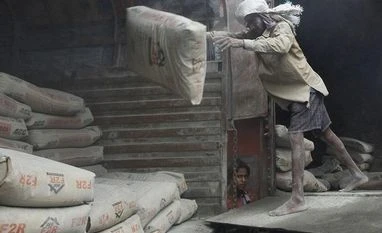 "GST impact: Cement growth in east India down from earlier projection")
WebinarsNew
Deep DiveNew
Explore Business Standard
NGT ban on sand mining in Bihar has been a dampener too
The earlier projection of 10 per cent cement sales growth this year in the eastern part of the country is likely to halve, as the region faces acute sand shortage, with a ban enforced by the Bihar government. Transition to the new Goods and Services Tax (GST) regime is also dampening sales, both at the wholesale and retail levels.
Bihar has 23 per cent of the cement market in the east. Analysts say it was previously growing at a 18-20 per cent annual rate but sales have halted there for three months. This has adversely affected the overall eastern region. As on September 30, overall growth in the east stood at four per cent.
"The more important part is that Bihar is a key producer of sand in east India and the ban on sand mining has not only affected growth in that state but the entire region," said an analyst with Motilal Oswal.
The National Green Tribunal's order of suspending sand mining activities during the monsoon season, which has been enforced to the fullest in the state, had disrupted the trade. That apart, a clamp by the Bihar government on illegal sand mining has exacerbated this. Before the ban, sand prices were Rs 300-350 a tonne if transported within a 10-km radius from the loading point. For every incremental increase of five km, the price increased by Rs 50 a tonne. After the ban, prices have shot up to Rs 1,100-1,400 a tonne in the grey market. Despite the Bihar government last month deciding to put half the residual stocks of seized sand for public bidding, the shortage prevails.
Industry officials, encouraged mainly by housing and infrastructure projects, apart from road construction activities, had projected the eastern market to outpace the national average growth. At the beginning of the current financial year, while it was projected that pan-India cement sales would increase by five to six per cent, sales in the east were anticipated to go up by at least 10 per cent.
On a previous occasion, while talking to this publication, H M Bangur, managing director at Shree Cement, opined, "In the east, the cement consumption is lower than the national average. This situation will change, as per capita consumption of cement in the east is likely to increase."
East India accounts for 17-18 per cent of the cement market in the country, of 300 million tonnes per annum (mtpa).
"Till the time the issue of sand availability is sorted out, Bihar is not likely to rebound. Construction activity in that state is practically at a halt," said R R Ravi, analyst with Centrum Broking. Cement company executives are hoping the issue might be sorted by substituting of artificial sand.
"Eventually, M-Sand (manufactured sand, produced from hard granite stone) will become an organised sector and the government is expected to sort the sand shortage issue in due course," said Vivek Chawla, chief executive at Emami Cement.
West Bengal, which accounts for 23 per cent of the 53 mtpa market in the east, also faced a demand crisis owing to the political shutdown in the Darjeeling hills. Analysts say it has led to a sudden drop in demand in northern Bengal (experiencing a surge in road construction), as well as having choked the supply line to the northeast region.
Further, the GST transition hasn't been smooth in the east, owing to huge volumes of cash transactions. Industry officials say dealers had resorted to destocking in June, in anticipation of GST, and the pace of restocking is still not satisfactory.
"It's mainly because of the still prevalent lack of clarity on GST rates and input credits," says the analyst with Motilal Oswal.
Nevertheless, Sabyasachi Majumdar, senior vice-president at ICRA Ratings, feels a demand rebound is likely from the third quarter of this financial year. "The demand growth is likely to be driven by a pick-up in the housing segment - primarily affordable and rural housing -- and the infrastructure segment - mostly road and irrigation projects," he said.
Nevertheless, the pan-India growth is likely to fall to 3.5-4 per cent from the previous projection of five per cent.
First Published: Oct 22 2017 | 12:07 AM IST


 Connect with us on WhatsApp