
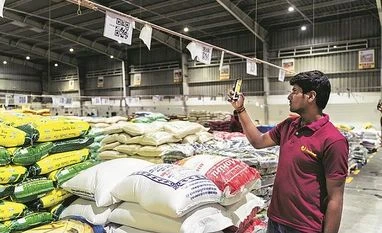
 "How grocery marketplace Jumbotail is preparing kirana stores for the future")


Sourcing supplies has become easier for Mohan since he started using an app to place orders. Every morning when Mohan opens his store, takes stock of his inventory, opens an app, checks prices and places his orders by 3 pm; he gets his consolidated supplies by the next morning. Mohan now doesn’t have to close his shop for half-a-day to go to the wholesale market nor does he need to block his capital and space in buying excess inventory.
Enabling this is Jumbotail, a B2B marketplace for food and grocery products that supplies to 20,000 kirana stores in Bengaluru. Founded by Stanford MBA classmates S Karthik Venkateswaran and Ashish Jhina in 2015, Jumbotail uses a modern supply chain to connect kiranas with vendors to address massive inefficiencies in product discovery, distribution, stock outs, and pricing.
Jumbotail owns and manages the entire supply chain, including a distribution centre and a fulfilment centre. It runs three platforms — the e-commerce marketplace, the supply chain platform, and financial services platform (credit from NBFCs).
‘‘We have a real understanding of what the problem is truly about, the underlying moving parts. This is a complex business. We have done a lot of work to simplify that,’’ Jhina. For instance, a retailer can pay for one transaction using a combination of these — cash, debit card and credit.
Jumbotail’s full-stack approach to modernising general trade through the tech-driven supply chain, data-driven merchandising and credit is the most scalable way to revolutionise grocery retail, says Nexus Venture Partners MD Sameer Brij Verma.
Opportunity
Over 95 per cent of India’s food and grocery consumption flows through nearly 10 million kirana stores. The food and grocery market is estimated at $300 billion in India. It is growing at 15 per cent CAGR and is likely to reach $600 billion by 2024. There are other organised players such as Metro Cash n Carry and WalMart’s Best Price Retail, and start-ups such as ShopKirana, Udaan, GramFactory and ShopX, but the real competition is from unorganised offline players. The Bengaluru market alone is estimated to be worth $2 billion. There are over 65,000 stores (these includes supermarkets, bakeries and paan shops — the segments Jumbotail doesn’t cater for) and 30,000-35,000 pure kirana stores. Around 20,000 of these buy 5-15 per cent of their supplies from Jumbotail.
Revenue model
Jumbotail charges a commission from sellers who list products on the platform and for supply chain services like warehousing fulfilment and last mile delivery. Brands pay for additional services like digital merchandising and placement, in-store product placement and sampling. Customers pay a shipping fee for storefront delivery and interest fee for credit. Credit providers pay for user acquisition and distribution of working capital and infrastructure loans availed by customers and sellers.
Expert Take: Kiranas will reinvent themselves
Despite the e-commerce boom, a vast majority or 90-94 per cent of the food and grocery market is still dominated by kiranas and other local outlets. In the last two decades, small retailers have reinvented themselves by consolidating purchases, adopting technology and customer orientation and by becoming cost-conscious.
Abheek Singhi MD and senior partner, BCG Consulting
In the next five to 10 years, kirana stores will still remain a significant part of the food and grocery market. But these outlets won't remain the same what they have been in the past or what they are today. In fact, they will continue to reinvent themselves. The core value that start-ups like Jumbotail bring to the table is to improve the ‘efficiency’ within the overall supply chain.
Of 12 million kirana stores, three-four million are served directly by the distributors of companies. Eight-nine million are served through some form of wholesale. Jumbotail can try to become equivalent of a master distributor across different brands and categories to reach out to these eight-nine million stores.
If we look at the fill rates, there is an opportunity from the wholesale perspective to improve efficiency for start-ups like Jumbotail. In this business, the concept of ‘scale’ is at a local level and not global. If a start-up is able to reach 20,000 outlets in one city, it may not scale much even if it reaches 100,000 outlets across 20 cities.
One subscription. Two world-class reads.
Already subscribed? Log in
Subscribe to read the full story →

Smart Quarterly
₹900
3 Months
₹300/Month
Smart Essential
₹2,700
1 Year
₹225/Month
Super Saver
₹3,900
2 Years
₹162/Month
Renews automatically, cancel anytime
Here’s what’s included in our digital subscription plans
Exclusive premium stories online

Over 30 premium stories daily, handpicked by our editors


Complimentary Access to The New York Times
News, Games, Cooking, Audio, Wirecutter & The Athletic
Business Standard Epaper
Digital replica of our daily newspaper — with options to read, save, and share


Curated Newsletters
Insights on markets, finance, politics, tech, and more delivered to your inbox
Market Analysis & Investment Insights
In-depth market analysis & insights with access to The Smart Investor


Archives
Repository of articles and publications dating back to 1997
Ad-free Reading
Uninterrupted reading experience with no advertisements


Seamless Access Across All Devices
Access Business Standard across devices — mobile, tablet, or PC, via web or app