China lands Chang'e-5 on lunar surface to bring back a piece of the Moon

China is on its way to join the elite club of nations with the capability to bring back samples from outer space to Earth
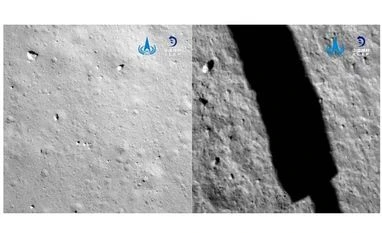
Lunar landing
The lunar surface as clicked by Chang'e-5 ahead of landing. (CNSA)
Shibu Tripathi New Delhi
4 min read Last Updated : Dec 02 2020 | 10:05 AM IST
Taking a lead in the newly commenced Moon race, China on Wednesday successfully landed its Chang'e-5 mission on the lunar surface to retrieve samples to be brought back to Earth. The second probe to be landed on the surface aims to collect rock samples and dust for further studies.

Chang'e-5 will collect samples for about two days in a region to the north of Mons Ruemker, a mountain overlooking a vast lunar mare called the Ocean of Storms. According to the Chinese National Space Administration, the probe will bring about 2 kilograms of lunar samples back to Earth in mid-December. Once completed it will be the first such sample to be brought to the planet, 44 years after the last substances from the moon were returned to Earth.

China had launched the Chang'e-5 spacecraft on November 24 onboard Long March 5 heavy-lift carrier rocket from the Wenchang Space Launch Center in Hainan province, comprising an orbiter, a lander, an ascender, and a re-entry capsule.

According to the space agency before landing, Chang'e-5 separated into two parts: the orbiter-reentry capsule combination and the lander-ascender combination. "While the lander-ascender has started surface operations, the orbiter-reentry capsule is in lunar orbit at an average altitude of about 200 km above the moon," the administration added.

"For the space program of China, this event is undoubtedly historic," Deputy Director-General of Roscosmos Sergei Savelyev said in a statement adding, "The study of the natural satellite of the Earth is currently one of the priority areas of space activities in all countries, and Russia and China regularly discuss the development of cooperation between our countries in this area." 
Named after Chinese moon goddess "Chang'e", China's lunar exploration programme, which began in 2004, includes orbiting and landing on the moon and bringing samples back to Earth. (CNSA)

The lunar descent and return home

The descent began at the scheduled time as the probe started its 7,500-newton-thrust engine to reduce its flying speed, lowering towards the surface from an altitude of 15 km. At about 2.5 km above the surface, the probe conducted a series of adjustments in its position as it approached the Moon. "The lander-ascender suspended its descent when it was about 100 meters from the moon and hovered for a short time to carry out accurate detection of obstacles before continuing to descend at a slower, steady speed," the administration said post landing.

The Chang'e-5 is the third probe to land on the lunar surface in the 21st century and China is on its way to join the elite club of nations with the capability to bring samples to Earth from outer space after the US and the Soviet Union.

During its two day operations, the probe will drill on the surface to retrieve rocks from a depth of 2 meters and gather soil samples using its robotic arms.
The Long Mach rocket that took Chang-5 to the Moon. (CNSA)

After finishing its work on the Moon, the ascender will rise from the lunar surface for rendezvous and dock with the orbiter flying around the Moon. Then the returner will fly back to Earth via the Earth-Moon transfer orbit, re-enter the atmosphere, and land at the Siziwang Banner (County) in Mongolia.

Named after Chinese moon goddess "Chang'e", China's lunar exploration programme, which began in 2004, includes orbiting and landing on the moon and bringing samples back to Earth. The programme has achieved five continuous successes, said CNSA, referring to Chang'e-1, Chang'e-2, Chang'e-3, a test craft for Chang'e-5 and the recent Chang'e-4, which realised the first-ever soft-landing on the far side of the Moon.

With the success of China, India is closely looking as the Indian Space and Research Organisation (Isro) swiftly moves ahead with the Chandrayaan-3 mission. The mission has been delayed by the coronavirus pandemic and the follow-up lockdowns. The launch which was planned for 2020 will now take off for the Lunar surface sometime in early 2021.
GSLV-MkIII-M1 rocket carrying Chandrayaan-2 lifts off from Satish Dhawan Space Centre, at Sriharikota in Nellore district of Andhra Pradesh | Photo: ISRO

Chandrayaan-3 will be a repeat of Chandrayaan-2 mission and will include a lander and rover similar to that of Chandrayaan-2, but will not have an orbiter, a statement quoting Singh said. Planned to land on the south pole of the Moon, Chandrayaan-2 was launched on July 22 last year. However, the lander Vikram hard-landed on September 7, crashing India's dream to become the first nation to successfully touch down on the lunar surface in its maiden attempt.

One subscription. Two world-class reads.

Already subscribed? Log in

Subscribe to read the full story →
*Subscribe to Business Standard digital and get complimentary access to The New York Times

Smart Quarterly

₹900

3 Months

₹300/Month

SAVE 25%

Smart Essential

₹2,700

1 Year

₹225/Month

SAVE 46%
*Complimentary New York Times access for the 2nd year will be given after 12 months

Super Saver

₹3,900

2 Years

₹162/Month

Subscribe

Renews automatically, cancel anytime

Here’s what’s included in our digital subscription plans

Exclusive premium stories online

  • Over 30 premium stories daily, handpicked by our editors

Complimentary Access to The New York Times

  • News, Games, Cooking, Audio, Wirecutter & The Athletic

Business Standard Epaper

  • Digital replica of our daily newspaper — with options to read, save, and share

Curated Newsletters

  • Insights on markets, finance, politics, tech, and more delivered to your inbox

Market Analysis & Investment Insights

  • In-depth market analysis & insights with access to The Smart Investor

Archives

  • Repository of articles and publications dating back to 1997

Ad-free Reading

  • Uninterrupted reading experience with no advertisements

Seamless Access Across All Devices

  • Access Business Standard across devices — mobile, tablet, or PC, via web or app

Topics :moonChandrayaan-3ISRO

Next Story



