Delhi's air quality remains 'very poor' due to 'unusually high' farm fires
The national capital's air quality remained very poor on Sunday with an unusually high number of farm fires negating the effect of better ventilation, according to a government forecasting agency
Press Trust of India New Delhi The national capital's air quality remained very poor on Sunday with an unusually high number of farm fires negating the effect of better ventilation, according to a government forecasting agency.
However, the situation is likely to get better by Monday.
The city recorded an air quality index (AQI) of 366 at 8:30 am. The 24-hour average AQI was 367 on Saturday, 374 on Friday, 395 on Thursday, 297 on Wednesday, 312 on Tuesday, and 353 on Monday.
An AQI between 0 and 50 is considered 'good', 51 and 100 'satisfactory', 101 and 200 'moderate', 201 and 300 'poor', 301 and 400 'very poor', and 401 and 500 'severe'.
According to the Ministry of Earth Sciences' air quality monitoring agency, SAFAR, the share of stubble burning in Delhi's PM2.5 pollution was 32 per cent on Saturday, the second highest this season so far.
It was 19 per cent on Friday and 36 per cent on Thursday -- the maximum so far this season.
According to the central government's Air Quality Early Warning System for Delhi, the fire count increased to an unusual high on Friday over Punjab (approx 4,266), Haryana (155), Uttar Pradesh (51) and Madhya Pradesh (381) impacting air quality in Delhi-NCR and other parts of northwest India.
NASA's satellite imagery showed a large, dense cluster of fire dots covering Punjab and parts of Haryana and Uttar Pradesh.
SAFAR said Delhi's AQI did not improve much despite better ventilation, mainly because of highly favourable north-north westerly boundary level wind direction and perfect wind speed for intrusion of pollutants from farm fires.
Increased local surface wind speed with faster dispersion conditions are counteracting with increased fire-related emission and associated intrusion. But still, AQI is likely to improve for the next two days as dispersion will eventually play a lead role, it said.
According to the India Meteorological Department, the predominant wind direction was northwesterly and the maximum wind speed was 15 kilometres per hour on Sunday.
Calm winds and low temperatures trap pollutants close to the ground, while favourable wind speed helps in their dispersion.
The city's ventilation index a product of mixing depth and average wind speed was expected to be around 8,500 metre square per second on Sunday favourable for dispersion of pollutants.
Mixing depth is the vertical height in which pollutants are suspended in the air. It reduces on cold days with calm wind speed.
A ventilation index lower than 6,000 sqm/second, with the average wind speed less than 10 kmph, is unfavourable for dispersal of pollutants.

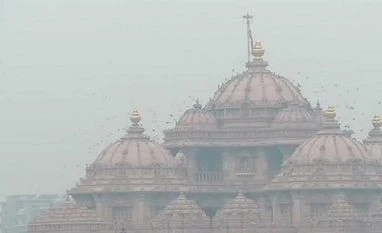 "Delhi's air quality remains 'very poor' due to 'unusually high' farm fires")

