Delhi's riot-hit areas: Provoked, poor, young, and significantly Muslim

Northeast Delhi's socio-economic profile shows it was a communally sensitive area where sparks lit by some irresponsible statements led to one of the worst riots in the city's post-1950 history

North East Delhi Violence
A look at the sequence of events shows that rioters indulged in serious provocation in heavily Muslim-dominated areas
Sai Manish
4 min read Last Updated : Mar 06 2020 | 2:48 PM IST
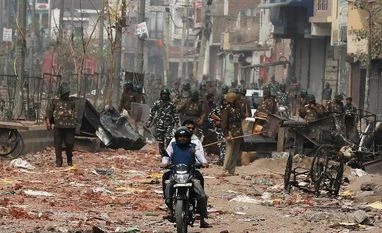
Even as Delhi limps back to a tense calm, more than 500 people have so far been picked up by Delhi Police for interrogation over their role in the deadly riots that took over 40 lives in five days, mostly in the city’s northeastern parts. A look at the area’s socio-economic profile shows that it was a communally sensitive area where a spark lit by irresponsible statements of certain political leaders led to one of the worst communal riots witnessed by Delhi in seven decades.

Anti-Citizenship Amendment Act (CAA) protests had been going on in other parts of Delhi for over two months, but what made Northeast Delhi volatile was the district’s significant Muslim population. Northeast Delhi has almost 30 per cent Muslim population – the highest among the city’s nine districts. Overall, Muslims proportion in Delhi’s population is just 13 per cent, lower than the national average.

On February 23, Bharatiya Janata Party (BJP) leader Kapil Mishra had delivered an allegedly provocative speech from Maujpur and specifically asked for mobilisation of people to clear the Jaffrabad locality of anti-CAA protestors. This is also the area where the body of slain Intelligence Bureau employee Ankit Sharma would be found dumped in a drain a few days later. About 70 per cent of Jaffrabad’s population is Muslim.

Three hours after Mishra’s speech, clashes were first reported in Karawal Nagar and Babarpur, both Hindu-dominated areas with significant Muslim population. Two out of every 10 people in Babarpur belong to the Muslim community. On the evening of February 24, violence spread to Gokalpuri, where a Delhi Police constable was also killed in communal violence. Gokalpuri and Babarpur have a similar religious composition.

Clashes also erupted in Seelampur, where a third of the population was Muslim. The very next day, rioters fired shots and pelted stones in Brahmpuri and Maujpur in Shahadra. The Muslim population was almost a third of the total here, too. A look at the sequence of events shows that rioters indulged in serious provocation in heavily Muslim-dominated areas. A mosque and madrassa were torched in Brijpuri, which lies right next to Mustafabad, where almost 80 per cent of the population is Muslim.

While some BJP politicians allegedly played their part, other politicians also entered the fray trying to mobilise people in the sensitive areas. Aam Aadmi Party (AAP) Councillor Tahir Hussain was booked for murder on February 27 after bricks and molotov cocktails were allegedly discovered from the terrace of his house in Khajoori Khas, an area where almost 60 per cent of the population is Muslim.

While most violence-hit areas were divided into Hindu and Muslim pockets, these had a higher proportion of young population than the rest of Delhi. This purportedly made provocation a lot easier. In Northeast Delhi, the proportion of those aged between 20 and 40 years in total population was almost 43 per cent -- higher than Delhi overall. In fact, Muslims in this age group constituted 46 per cent of the population (higher than Hindus).

A host of debilitating economic factors are an overarching feature of the district. Many young people in the area start dropping off school after completing secondary education. Its graduation rates are half of the 14 per cent national average and significantly lower than Delhi’s average. This makes its relatively high young population less acceptable in the job market. Two-thirds of the population here lives in either one-room or two-room houses in buildings packed together like a can of sardines in narrow bylanes.

Many of these areas are ghettoised along communal lines, with communities generally asserting their presence by constructing temples and mosques. Despite their significant Muslim population, only two of the eight Assembly constituencies in Northeast Delhi – Seelampur and Mustafabad – have been retained by Muslim candidates over the years. In the 2020 Delhi Assembly election, the BJP won three of its eight seats in this communally sensitive district. In 2015, Kapil Mishra, the BJP leader accused of igniting the riots by the families of some victims, had been elected from Karawal Nagar as an AAP candidate. In the just concluded polls, Mishra contested from Model Town on a BJP ticket but lost to the AAP's Akhilesh Pati Tripathi.

One subscription. Two world-class reads.

Already subscribed? Log in

Subscribe to read the full story →
*Subscribe to Business Standard digital and get complimentary access to The New York Times

Smart Quarterly

₹900

3 Months

₹300/Month

SAVE 25%

Smart Essential

₹2,700

1 Year

₹225/Month

SAVE 46%
*Complimentary New York Times access for the 2nd year will be given after 12 months

Super Saver

₹3,900

2 Years

₹162/Month

Subscribe

Renews automatically, cancel anytime

Here’s what’s included in our digital subscription plans

Exclusive premium stories online

  • Over 30 premium stories daily, handpicked by our editors

Complimentary Access to The New York Times

  • News, Games, Cooking, Audio, Wirecutter & The Athletic

Business Standard Epaper

  • Digital replica of our daily newspaper — with options to read, save, and share

Curated Newsletters

  • Insights on markets, finance, politics, tech, and more delivered to your inbox

Market Analysis & Investment Insights

  • In-depth market analysis & insights with access to The Smart Investor

Archives

  • Repository of articles and publications dating back to 1997

Ad-free Reading

  • Uninterrupted reading experience with no advertisements

Seamless Access Across All Devices

  • Access Business Standard across devices — mobile, tablet, or PC, via web or app

Topics :Citizenship BillDelhi Riots 2020Delhiprotests

Next Story




