India's first exclusive defence satellite GSAT-7 was successfully launched by European space consortium Arianespace's Ariane 5 rocket from Kourou spaceport in French Guiana today, giving a major push to the country's maritime security.
Indian Navy would be the user of the multi-band home-built communication spacecraft, expected to be operational by September end.
The Rs 185-crore GSAT-7, the country's maiden dedicated spacecraft for Defence applications, was launched during a 50-minute launch window which started at 2 am, and it was telecast live by Doordarshan.
After a flight of almost 34 minutes, the satellite was injected into a Geosynchronous Transfer Orbit (GTO) of 249 km perigee (nearest point to earth), 35,929 km apogee (farthest point to earth) and an inclination of 3.5 degree with respect to the equator.
During August 31-September 4, three orbit-raising operations will be performed by Indian Space Research Organisation (ISRO) to place the satellite into geostationary orbit of 36,000 km above the equator.
By September 14, GSAT-7 is planned to be positioned in its orbital slot of 74 deg East longitude and subsequently the satellite's communication transponders will be switched on.
The frequency bands of GSAT-7 will help space-based marine communications. It has coverage over India landmass as well as surrounding seas.
"It's important from security and surveillance points of view", an ISRO official said.
According to a senior space scientist, so far the Navy had limitation from line of sight and ionospheric effects, among others, as far as space-based communications were concerned.
It was thought essential to have an integrated platform for the Navy's exclusive use.
Earlier, satellite communication in ships was through Inmarsat, a major provider of global mobile satellite communications services.
The state-of-the-art satellite carrying payloads operating in UHF, S, C and Ku bands, had a lift-off mass of 2625 kg and is based on ISRO's 2500 kg satellite bus with some new technological elements, including the antennae.
According to ISRO, GSAT-7 is an advanced communication satellite to provide wide range of service spectrum from low bit rate voice to high bit rate data communication. Its payload is designed to provide communication capabilities to users over a wide oceanic region including the Indian land-mass.
The launch cost for ISRO is around Rs 470 crore, including insurance.
ISRO cannot launch heavy satellites like GSAT-7 as its home-grown GSLV rocket, with indigenous cryogenic stage, is still at works and needs two successful flights before it is declared operational.
In addition to GSAT-7, the Ariane 5 orbited another spacecraft EUTELSAT 25B/Es'hail.
EUTELSAT 25B/Es'hail 1 – which rode in the top position of the Ariane 5 payload "stack" – separated first, some 27 minutes after liftoff.
At approximately 34 minutes into the flight, the lower passenger – GSAT-7 – was deployed, completing the mission.
Indian Ambassador to France, Arun Singh and Director of Bangalore-based ISRO Satellite Centre, S K Shivakumar, were among those who witnessed the launch.
Singh said the launch event is also a reflection of strategic partnership between India and France. Shivakumar said GSAT-7 would be operational by next month-end.

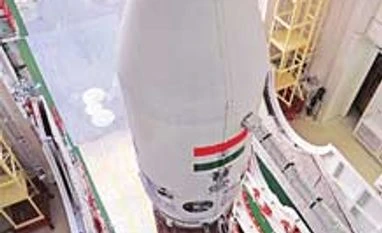 "India's first military satellite GSAT-7 launched successfully")


 Connect with us on WhatsApp