Chief of Defence Staff (CDS) General Bipin Rawat dispelled apprehensions on Wednesday that the creation of theatre commands to increase the synergy among the Army, Navy and Air Force would lead to one service usurping the other two as he described such concerns as a "misnomer".
In an address at the Vivekananda International Foundation, he said the three service chiefs had given in writing to the government around two years ago that they wanted an integrated system to come in.
The CDS said integration and jointness among the three services are important for the country to face future security challenges.
"There is always hesitation to change. We are a status-quoist nation.... There is a feeling that the Army being the large service compared to the Navy and the Air Force, it will possibly usurp the two entities and possibly everything will become Army-centric. This is a misnomer," he said.
General Rawat was replying to a question on the challenges being faced in the creation of the proposed theatre commands.
General Rawat took over as the country's first CDS on January 1 last year with a mandate to bring in convergence among the three services and restructure the military commands to effectively deal with future security challenges.
He also said all the radar systems of the three services will be integrated to ensure optimum utilisation and they will operate under an overall air defence umbrella.
According to the plan, the theatre commands will have units of the Army, Navy and Air Force and all of those will work as a single entity, looking after security challenges in a specified geographical territory under an operational commander.
"Two years ago, the three service chiefs gave in writing to the government that we want an integrated system to come in. That is how the CDS came into being," General Rawat said.
He said work is being done towards creating two to three integrated theatre commands (ITCs) over land, a maritime theatre command (MTC) and a national integrated air defence command (ADC).
He said the Chiefs of Staff Committee with the CDS, as a "first among equals" concept, could be the coordinating agency for allocation of resources, based on the requirements projected by the theatre commanders.
As the system matures, the command would flow from the CDS to the individual theatre commanders and the service headquarters would then be primarily responsible for "raise, train and sustain", General Rawat said.
He said in an environment of ambiguity, uncertainty and frequent opacity, the political leadership needs to be provided with comprehensive, complete and evaluated options on matters of national security in the form of a "single-point advice".
"To ensure security, there needs to be an institutionalised approach, wherein properly designed institutions of national security with defined roles and responsibilities and a robust mechanism to bring disparate institutions together to be able to work in sync with each other is a prerequisite," the CDS said.
He said a greater emphasis would now be on advancing jointness and integration across the board so as to develop trust amongst the rank and file and shape congruent perception to jointly operate efficiently and effectively.
In his address, General Rawat also said India's aspiration of becoming a regional power cannot rely on "borrowed strengths", adding that the country will have to win its wars with "Indian solutions".
In this context, he also underlined the need for integrating civil and military technological efforts.
"India today is at the cusp of great opportunities and increased responsibilities.
"Though these auger unique challenges, yet we stand as a confident, articulate and rising nation, willing to claim our rightful place in the comity of nations and shifting of the global strategic perspective to focus on India," General Rawat said.

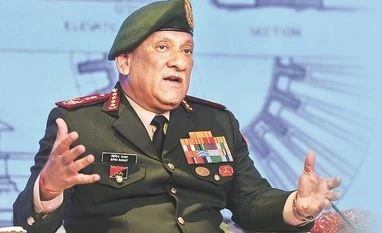 "Integration among 3 services key to face future security challenges: CDS")


 Connect with us on WhatsApp