One is a media magnet; the other, a quiet performer. Gujarat Chief Minister Narendra Modi is the quintessential campaigner, never losing an opportunity to highlight his achievements, while Madhya Pradesh Chief Minister Shivraj Singh Chouhan lets his action speak.
The question is whose leadership has had more impact?
Some indicators point towards a close contest. Modi took charge of Gujarat in late 2001, while Chouhan became chief minister of MP in November 2005. Under Modi, BJP scored a hat-trick of electoral successes in Gujarat. Chouhan's supporters are hoping for an encore in the Assembly elections in Madhya Pradesh, due later this year.
(On a growth Path) Modi's supporters credit him for scripting an unprecedented growth story in the state during his decade-long tenure. Economic growth has been impressive, led by a spurt in farm production. In the last five years, agriculture has grown a whopping 11 per cent. MP's record on this count has been equally impressive, with growth of 9.04 per cent; in 2011-12, the state's agriculture sector grew 18 per cent, higher than all other states.
In terms of overall economic growth, there has been a close contest between the two states. According to a Planning Commission working paper, Gujarat registered annual growth of 9.8 per cent between 2007 and 2011, a clear 2 per cent more than the national average, against expectations of 11.2 per cent. MP exceeded expectations of 6.7 per cent, growing 9.1 per cent in the same period.
The popularity chart "The style sheet (of the two states) might be different, but the output has been the same," says Sanjay Kumar, fellow at the Centre for the Study of Developing Societies (CSDS). CSDS surveys in MP and Gujarat clearly indicate when it comes to popularity and satisfaction with the government's performance, there is hardly any difference between Modi and Chouhan, in their respective states. "Modi is a popular leader in Gujarat; so is Chouhan in MP. Our surveys clearly brought this out," says Kumar.
In the last decade, the two BJP-ruled states have made substantial progress in power generation and distribution. MP had total installed power capacity of 4,884 Mw in 2003-04, which rose to 9,288 Mw in March 2013, a rise of 90 per cent. In the same period, Gujarat registered a growth of about 165 per cent -from about 9,000 Mw in 2003-04, total installed capacity rose to 23,887 Mw in March this year.
The fall in transmission and distribution (T&D) losses in the two states has been equally impressive. For Madhya Pradesh, T&D losses fell from a whopping 49.55 per cent in 2003-04 to 27.11 per cent this year. In Gujarat, these declined from 35 per cent to a modest 15 per cent in the same period. As a result, both states have become power-surplus, an impressive feat, considering the sorry state of the power sector across the country.
Some economists, however, are unwilling to be floored by such numbers. "When the country was growing at eight per cent, they grew at more than nine per cent. There is nothing extraordinary about that," says V Upadhyay, professor of economics at Indian Institute of Technology-Delhi.
While Modi can claim credit for the hype around the Vibrant Gujarat summits, Chouhan deserves kudos for better management of public finance. While Madhya Pradesh has consistently been revenue-surplus for about a decade, Gujarat was revenue-surplus only in 2011-12 and 2012-13. Tax revenue, as percentage of gross state domestic product (GSDP), has been about eight per cent in Madhya Pradesh, compared with seven per cent in Gujarat during this period. Madhya Pradesh's revenue receipt, as percentage of GSDP, has been around 20 per cent between 2004 to 2012-13, compared with a modest 10 per cent in Gujarat. Even more impressive has been the Madhya Pradesh government's generous spending on development and social sector programmes. In the last decade, development expenditure, as a percentage of GSDP, has been in high double digits in the state, compared with eight per cent in Gujarat.
Social indices Though Madhya Pradesh has been neck and neck with Gujarat, in terms of economic parameters, the former has to do a great deal more on social indices. At 59, the infant mortality rate in Madhya Pradesh is much above Gujarat's 41. Also, Madhya Pradesh's female literacy rate of 60 per cent is much lower than Gujarat's 70.73 per cent. Both states, however, fare poorly when it comes to the ratio of girl children to boys - Madhya Pradesh's 930 and Gujarat's 918 are well below the national figure of 940.
When it comes to innovation in governance, Madhya Pradesh is ahead of Gujarat. While Gujarat has been reluctant to have a Lokayukta, the one in Madhya Pradesh is very active. In 2010, the Madhya Pradesh Public Service Guarantee Act was implemented to make government officials accountable. Another innovation was the Ladli Laxmi Yojana, which sought to create a positive environment for the birth of a girl child, by providing financial assistance. This has been replicated in many states.
Given his track record as a quiet performer in a state that had a poor socio-economic profile in the not-so-distant past, some in the BJP say if Chouhan can ensure a victory for the party in the Assembly elections in the state, he should be treated on a par with Modi. Political observers say the section in the BJP rooting for Chouhan has valid reasons to do so; Chouhan has not only been a doer, but also a non-controversial figure, much in the Atal Behari Vajpayee mould. The BJP would need such a leaders not only to keep the National Democratic Alliance flock together, but also to win over allies, they say.
Both Modi and Chouhan belong to Other Backward Classes, both started as Rashtriya Swayamsevak Sang pracharaks and both have turned out to be able administrators. Despite a close contest, when it comes to performance, Modi seems to hold the pole position, as of now. But on the political stage, the emergence of a dark horse is always a possibility, as the country has often seen since 1991.

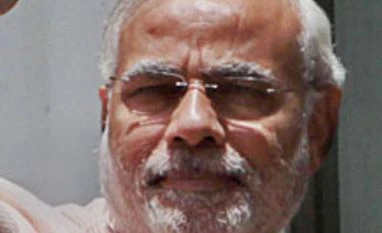 "Tale of two titans: Rockstar versus Mr Dependable")


 Connect with us on WhatsApp