Back in 2012-13, India were trailing 1-2 in the four-match Test series against England, and then skipper Mahendra Singh Dhoni deployed a three-spinner attack in the final Test at Nagpur, including Jadeja. It was a desperate ploy but India didn’t win the match, or salvage the series. The team did manage to find a resolution to its spin woes though.
A couple of months later, Jadeja helped destroy Australia in a 4-0 rout at home, including dismissing their captain, Michael Clarke, five times in six innings. Jadeja finished with 24 wickets in that series, cementing his place in the Indian Test side. Even so, for most people watching from outside the boundary line, this was an idea they couldn’t easily fathom.
It has to do with his batting exploits in domestic cricket. Aided by the slow and low wickets at Saurashtra Cricket Stadium in Rajkot, Jadeja is the only Indian cricketer to boast of three first-class triple hundreds. Even the likes of VVS Laxman, Cheteshwar Pujara and Wasim Jaffer, all proper top-order batsmen, boast of only two first-class triple tons.
Consider this: until the 2015-16 home season, three years after he had made his Test debut, Jadeja had one Test half-century to his name in 12 matches, with a highest of 68 at Lord’s in 2014. In 2012, Dhoni had clearly outlined that he saw Jadeja as a useful all-rounder in Test cricket. Yet, despite unending faith in his ability, the return in investment — 364 runs and 45 wickets in 12 Tests — simply wasn’t there.
However, Jadeja couldn’t simply be sidelined. There were a couple of reasons for this. One, India were on a never-ending overseas cycle that saw them play in South Africa, New Zealand, England and Australia. During this period, the team management preferred Jadeja over Ravichandran Ashwin as the frontline spinner and he picked up 18 wickets from 7 overseas Tests.
Playing Jadeja was also an efficient option. Even if he couldn’t contribute big runs, he could hold one end up with the ball. His real value to the team, however, was still in limited-overs cricket.
This is where Jadeja derives his confidence. Difficult spinner to get away, check; useful, aggressive lower-order batsman, check; electric fielder, check. When wearing blue, he truly belongs on the field of play.
While India has witnessed a spate of small-town cricketers rising to the upper levels in the last decade or so, it isn’t easy to balance this limelight with performance. For Jadeja, it was a double-edged sword — pun unintended — because he was also carrying the baggage of his superlative domestic performances.The early half of his international career can be defined as a personal struggle to strike a balance between the two. He was searching for an identity.
The 2015-16 season proved to be pivotal in this regard. Jadeja had missed the 2014-15 Australia tour owing to a shoulder injury, and didn’t enjoy an impactful 2015 World Cup, either. He was dropped from both the Test (for Sri Lanka tour) and one-day international (for Zimbabwe tour) teams thereafter.
“There were a lot of negative thoughts in my head and I needed to get rid of them. So for three months, I didn’t even think of cricket. I just went horse riding and concentrated on my personal life. I took my mind off cricket,” Jadeja said of that tough phase on his return to international cricket in the autumn of 2015.
When the 2015-16 domestic season started, Jadeja picked up six consecutive five-wicket hauls in the Ranji Trophy for Saurashtra, and steamrolled his way back into the Test side for the South Africa series at home. He took 23 wickets in four Tests and hasn’t looked back since.
“There is this immense self-belief about him. He was and remains a confidence player,” says Shitanshu Kotak, coach of the Saurashtra Ranji team. “It is perhaps his strongest quality. He had lost confidence when he was dropped, but being surrounded by people who believe in him rejuvenated him.”
The motto of the current international set-up, led by Virat Kohli and Ravi Shastri, is to lead this Indian team by galvanising each player’s individual persona. Like Dhoni, Kohli keeps a tight check on how the game is progressing, but unlike his predecessor, he also likes the players to express themselves on the field.
Since 2015, Jadeja has transformed into the Test cricketer he was expected to be. Consider his statistics since the South Africa series: 772 runs, including seven half-centuries, and 110 wickets, including seven five-wicket hauls in 20 Tests.
“In the last 10-12 months, Jadeja has worked extremely hard on his batting. Earlier he bowled so much that other disciplines were left behind, now he is catching up. Players who have both abilities are very rare to find and they are precious in the longer format because they provide you with great balance,” said Kohli after the conclusion of the second Test against Sri Lanka — where Jadeja was man of the match — last week.
For Jadeja, though, this is the completion of an individual circle. He wasn’t part of the team that beat Sri Lanka two years ago.
When the third Test starts in Pallekele today, India will have to do without him. His one-match suspension leaves a gaping hole in the lower order; Kuldeep Yadav and Axar Patel have huge boots to fill.

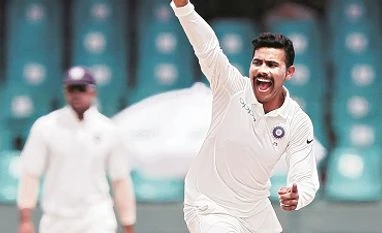 "The indispensability of Ravindra Jadeja")












 Connect with us on WhatsApp