The Supreme Court would on Tuesday pronounce a historic judgement on the controversial issue of whether the practice of 'triple talaq' among Muslims is fundamental to the religion.
A five-judge constitution bench headed by Chief Justice J S Khehar had reserved its verdict on May 18 after a six-day marathon hearing during the summer vacation.
During the hearing, the apex court had clarified that it may not deliberate upon the issue of polygamy and said it would only examine whether triple talaq was part of an "enforceable" fundamental right to practice religion by the Muslims.
Besides CJI Khehar, the bench also included Justices Kurian Joseph, R F Nariman, U U Lalit and S Abdul Nazeer.
The bench, made up of judges from different religious communities -- Sikh, Christian, Parsi, Hindu and Muslim, had heard seven pleas, including five separate petitions filed by Muslim women challenging the prevalent practice of 'triple talaq' in the community.
The petitioners had claimed that the practice of 'triple talaq' was unconstitutional.
The Muslim women, who had filed the petitions, have challenged the practice of 'triple talaq' in which the husband pronounces 'talaq' thrice in one go, sometimes even by phone or a text message, to get a divorce.
During the hearing, the apex court had observed that the practice of 'triple talaq' was the "worst" and "not a desirable" form of dissolution of marriage among Muslims, even though there were schools of thought which called it "legal".
Several lawyers, including noted jurist Ram Jethmalani had attacked the practice on various constitutional grounds, including the right to equality and termed it "abhorrent".
It was argued that triple talaq was a discrimination on the ground of sex and this practice was abhorrent to the tenets of holy Quran and no amount of advocacy can save this "sinful" practice which is contrary to constitutional tenets.
The Centre had told the bench that it will come out with a law to regulate marriage and divorce among Muslims if 'triple talaq' is held invalid and unconstitutional by the apex court.
The government had termed all the three forms of divorce among the Muslim community -- talaq-e-biddat, talaq hasan and talaq ahsan, as "unilateral" and "extra-judicial".
It has said that all personal laws must be in confirmity with the Constitution and rights of marriage, divorce, property and succession has to be treated in the same class and has to be in conformity with the Constitution.
The Centre had said 'triple talaq' is neither integral to Islam, nor a "majority versus minority" issue but rather an "intra-community tussle" between Muslim men and deprived women.
The apex court had said it was keeping open for adjudication in the future the issues of polygamy and 'nikah halala' among Muslims as the Centre had insisted deliberations on these aspects as well.
Senior advocate Kapil Sibal, appearing for All India Muslim Personal Law Board (AIMPLB), had equated the issue of 'triple talaq' with the belief that Lord Rama was born in Ayodhya and these were matters of faith which cannot be tested on grounds of constitutional morality.
He had argued that triple talaq has been there since 637 AD and cannot be termed as un-Islamic as Muslims have been practising it for last 1,400 years.
Sibal had said that either Parliament can enact a law or it should be left to the community itself to deal and the court should not interfere on the issue.
The apex court during the hearing had asked the AIMPLB whether a woman can be given an option of saying 'no' to triple talaq at the time of execution of 'nikahnama' (marriage contract).
It had asked Muslim bodies how a practice like triple talaq could be a matter of "faith" when they have been asserting that it is "patriarchal", "bad in theology" and "sinful".
The batch of pleas had also challenged the constitutional validity of other practices like 'nikah halala' and polygamy among Muslims.
The bench had taken up the main matter on its own as a petition titled "Muslim Women's quest for equality".
The apex court had on its own taken cognisance of the question whether Muslim women faced gender discrimination in the event of divorce or due to other marriages of their husbands.

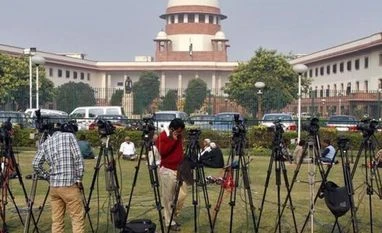 "Triple talaq: SC to pronounce judgement today")


 Connect with us on WhatsApp