88% more households sought work under MGNREGS in October, shows data

Of 24.3 mn households that demanded work, only 16.3 mn got it
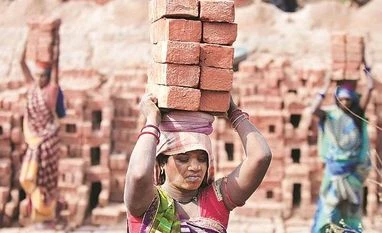
construction, realty, real estate, workers, labourer, labour, women, woman, jobs, migrant workers, mgnrega
The late monsoon season — coinciding with the kharif harvesting period — usually sees the least work demand in the year, at about 50-70 per cent of the peak demand that happens in June
Sanjeeb MukherjeeAbhishek Waghmare New Delhi
3 min read Last Updated : Nov 04 2020 | 6:10 AM IST

Don't want to miss the best from Business Standard?

Demand for MGNREGS work in October — though much less than the peak months of May and June — is still significantly higher than the corresponding period of 2019-20.

Between April and September, over 80 per cent of those who sought work under the scheme have got employment.

In October, while around 24.3 million households demanded work under MGNREGS, nearly 16.3 million actually got work. This leaves a preliminary unmet demand of around 8.1 million households.

Sources said the trend of unmet demand should not be derived from data of one month. This is because many times, if people seek work in one month, they get it in the subsequent months and hence a trend of 3-5 months should be considered for this.

In total, the data sourced from MGNREGS website shows that around 24.3 million households demanded work under the scheme in October 2020. This is 88.37 per cent more than the same period last year and 52.50 per cent more than October 2018.

Clearly, despite a seasonal drop in work demand under the scheme due to sowing of the kharif crop, MGNREGS work continues to be in high demand in rural India. In August, September and October, around 24.3-24.4 million households sought work under the scheme every month, while in 2019 this number was around 13-14 million households.

The late monsoon season — coinciding with the kharif harvesting period — usually sees the least work demand in the year, at about 50-70 per cent of the peak demand that happens in June.

But demand is substantially ahead of the previous year, with at least 10 million more households demanding work in August, September and October this year. “The narrative that is being built is that since migrant workers are going back to the cities and peak farming season is on, demand has gone down. But the data shows that people are still demanding MGNREGS work in great numbers. Anyway, the kharif harvests are awaited and people need cash to cope with their economic losses during lockdown. So, the demand has been consistently high this year. However, the allocation is not commensurate with this,” said Debmalya Nandy of the MGNREGS Sangharsh Morcha.

He said work demand would have been more but lack of adequate schemes and underawareness are the reasons why it is restricted. 

In most areas, the implementation is supply driven and not demand based (that is, people work when the officer, contractor or the supervisor ask them to do so). Hence, the actual demand can’t even be mapped through the official numbers.

The Centre, in its 2020-21 Budget, allocated around Rs 61,500 crore for the scheme. This was almost 13.3 per cent lower than the revised estimate of 2019-20. However, with demand for MGNREGS work surging during the lockdown — as migrant labourers returned to their villages — the Union government enhanced the allocation by Rs 40,000 crore. This made the 2020-21 allocation the highest ever in the scheme’s history to over Rs  1 trillion. Of this, around Rs 16,000 crore pertained to previous year’s liabilities, leaving around Rs 86,000 crore for fresh expenditure this year.


One subscription. Two world-class reads.

Already subscribed? Log in

Subscribe to read the full story →
*Subscribe to Business Standard digital and get complimentary access to The New York Times

Smart Quarterly

₹900

3 Months

₹300/Month

SAVE 25%

Smart Essential

₹2,700

1 Year

₹225/Month

SAVE 46%
*Complimentary New York Times access for the 2nd year will be given after 12 months

Super Saver

₹3,900

2 Years

₹162/Month

Subscribe

Renews automatically, cancel anytime

Here’s what’s included in our digital subscription plans

Exclusive premium stories online

  • Over 30 premium stories daily, handpicked by our editors

Complimentary Access to The New York Times

  • News, Games, Cooking, Audio, Wirecutter & The Athletic

Business Standard Epaper

  • Digital replica of our daily newspaper — with options to read, save, and share

Curated Newsletters

  • Insights on markets, finance, politics, tech, and more delivered to your inbox

Market Analysis & Investment Insights

  • In-depth market analysis & insights with access to The Smart Investor

Archives

  • Repository of articles and publications dating back to 1997

Ad-free Reading

  • Uninterrupted reading experience with no advertisements

Seamless Access Across All Devices

  • Access Business Standard across devices — mobile, tablet, or PC, via web or app

Topics :MGNREGAMGNREGSIndian Economy

Next Story



