Couldn't save Nokia Chennai as it became an orphan: Ravi Shankar Prasad
Interview with Union minister of law, telecom & information technology
Surabhi Agarwal Being the information technology minister for the country, in a government with a massive agenda on it, is quite a task.
Ravi Shankar Prasad, the Union minister of telecommunications, information technology and law & justice, is putting in 14-15 hour workdays. In an interview with
Surabhi Agarwal, he talks on various issues on his plate. Edited excerpts:
There has been quite a buzz around the 'Make in India' campaign. When do we see it getting converted into actual investments? 'Make in India' cannot be sold unless the leadership inspires confidence and trust. The hope deficit is not there anymore. From mobile phones to set-top boxes to LED lights to smart cards to SIM cards, 60 per cent of defence manufacturing is electronics…there is a huge sector waiting to be tapped properly. There were certain incentives from before and we tweaked these. We have also approved nine electronic clusters in the country. But, you have to give some time.
After the initial rush, the big investments are slowing. Do we need to do more than offer tax sops? We have already addressed the issue of an inverted duty structure. My theme for all foreign investors is that if (you) have any problem, walk into my chamber. Not only me, the entire department is willing to walk the extra mile for you.
But you have not been able to save Nokia (their factory near Chennai). Nokia is a separate case altogether, though unfortunate. Nokia Chennai became an orphan after Nokia sought to sell its assets to a buyer. And, to the best of my knowledge, the new buyer was reluctant to take over the liability of the Nokia plant. The difficult situation of that plant arose out of a peculiar circumstance, local to a particular transaction. It cannot be seen as an impression that India is not moving. Even in the US, an Indian company would pay tax. A tax regime is everywhere; it has to be fair and stable. And, that we have promised.
You have often said e-commerce is revolutionary. But the sector is hitting regulatory hurdles from all sides, be it the Reserve Bank or Enforcement Directorate or tax… GST (the national goods and services tax) is coming about, it will have a uniform (taxation) regime. It (e-commerce) is an area of great promise and as the IT minister, it is my job to ensure an enabling atmosphere for its growth, along with the traditional grocery shop owners. Their interest will also not be completely lost sight of.
But, how do we ensure new-age companies such as Uber are not scared away from India? I have told my officials in the IT ministry to work out a proper and clear guideline for them. On the taxation issue, we have to look into it. The direction of these guidelines will be towards providing a stable and pro-growth environment, whatever is needed to be done. All those who administer taxation also need to understand that the growth potential of this area should not be hindered by a non-productive outlook. They should help to create a favourable environment.
Is the auction of the 2100 MHz band possible anytime soon? I will not go into any specifics. The Telecom Regulatory Authority has given recommendations and the department is working on these. I have told my officers to have a fair regime, with twin objectives in mind - consumer interest, with growth of the sector. The spectrum sharing and trading guideline will be in place by the year-end. The auctioneer has already been appointed. We should now allow the process of auction to go on.
The mandate of this always on-hyper connected government is taking a toll on ministers, officials… I differ with you. Most ministers are favourably disposed. State governments which were under an apprehension have understood the potential of (information) technology. The PM himself has suggested let's explore the possibility of an e-cabinet meeting. There is a good example of an e-Vidhan Sabha in Himachal. These are all examples of explosion of potential and my job as the minister is to facilitate that.

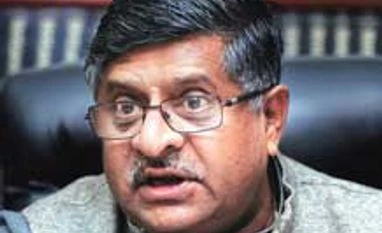 "Couldn't save Nokia Chennai as it became an orphan: Ravi Shankar Prasad")


 Connect with us on WhatsApp