Demonetisation was not an appropriate response to the black money issue, former Prime Minister Manmohan Singh today said and suggested that the government simplify tax and administration systems to address it.
The answer to black money problem was to simplify our tax, land registration and the administration systems. That was the only way in which the country could move forward in a society where there was less role for black money generation, Singh said interacting with students of St Teresa's College, Ernakulam, Kochi.
Singh said he believed that demonetisation was not an appropriate response to the black money problem. He said demonetisation had caused a lot of distress to farmers, small industrialists and many people died while standing in queues in front of banks to get cash because of the ban of Rs 500 and Rs 1,000 currency notes last year.
Asked how demonetisation has affected India's economy, Singh said it has put the economy in a state of stagnation.
"There are people who believe that the economy will soon recover to its normal speed. I am doubtful. My own feeling is that the next one year, the economy will remain in doldrums and therefore demonetisation has harmed the process of economic development to that extent," he said.
Earlier, Inaugurating National Seminar on "Macroeconomics Developments in India: Policy Perspectives" at St Teresa's College, Singh said the last few decades of rapid economic development have been accompanied by rising income inequality both at the individual and regional levels.
"Social mobility in India continues to be restricted, especially among the lower castes and minorities. Recent economic research has pointed out how income inequality in India has grown since independence," he said.
Singh said economists have also pointed out how state-level regional inequality has also grown in independent India where some states were outperforming the rest.
"It is time we pause, step back and recalibrate our macroeconomic thought that will acknowledge both the virtues and pitfalls of free markets," Singh said.
He lamented that nature of economic development was not leading to the creation of enough jobs to absorb all the new entrants to the labour force estimated at 10-12 million per annum.
Inequality and joblessness could be extremely dangerous in a diverse nation like India. There were no easy economic solutions for these problems as the world grapples with the dilemma of balancing the benefits and damages caused by globalisation, market failures and domestic imperatives, Singh said.
He said the first three decades of India's economic policy focused on nation building through a strong state, developing capabilities in private enterprise and providing strong social foundations for economic development.
The next three decades of economic policy have been driven by increased private sector participation and a smaller role for government.
"Today we stand at the threshold of another beginning."

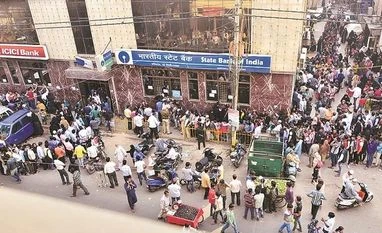 "Demonetisation killed people in ATM queues, put India in doldrums: Manmohan")

