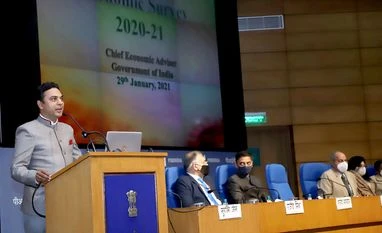
If intrinsically, the cycle is sharper than counter-cyclicality, it makes that cycle much lower and reduces macroeconomic uncertainties. Then private agents realize that even if there is a shock, the government may move in and act counter-cyclically to remove uncertainties and that increases the investment. So, rather than cutting and pasting from advanced economies, we should use basic economic principles to think about what is right for India at the stage of development at which we are.
The idea is that if you actually borrow and make an investment and that investment generates a greater return than the interest you have to pay, then that project is worthwhile. That is the basic idea.
But if I tell you that look if you won’t give me the right price, I can go and sell it to the other group then you will actually respond and give me the right price. That is the fundamental, which John Nash had shown in his Nobel prize-winning work about this market-based trades. So what the farm laws basically do is to provide that option, so once the small farmer says that I don’t need to sell it to you and I have another option, the value that he gets goes up significantly even within the APMC as well. That is the economics of these laws. However, there are other dynamics which are going on, some misinformation in the case of agriculture. Economics is very clear that it will benefit the small farmers and even the International Monetary Fund commended this and said that it indeed will help the small farmers.
The uncertainty is yet not over, this is not in India but across the world when households face uncertainty, and even some of the service sectors which are the crucial part of the economy are still affected by the contact-sensitivity and the social distancing. However, as the vaccination programs proceed ahead, these contact sensitive sectors will actually get their vibrancy back. But even though the vaccination drive is going fast, we haven’t yet reached the large part of the population.
On the ability to repay, if you take out the total obligations, including the private sectors’s foreign exchange obligations, our reserves are greater than that. It means that even if every private sector firm has foreign exchange obligations and they approach the Reserve Bank, seeking foreign exchange, to repay, each one of them together, including a minuscule amount of sovereign as well can be taken care of. Similarly, if a company which has a lot of cash sitting on his books then the debt has to repay, you have to just dig into the cash and pay the debt in full, which means the probability of default is actually zero, which is what conveys the fundamentals. We have been internally deliberating with the rating agencies, regulators and other stakeholders about this.
One subscription. Two world-class reads.
Already subscribed? Log in
Subscribe to read the full story →
Smart Quarterly
₹900
3 Months
₹300/Month
Smart Essential
₹2,700
1 Year
₹225/Month
Super Saver
₹3,900
2 Years
₹162/Month
Renews automatically, cancel anytime
Here’s what’s included in our digital subscription plans
Exclusive premium stories online
Over 30 premium stories daily, handpicked by our editors


Complimentary Access to The New York Times
News, Games, Cooking, Audio, Wirecutter & The Athletic
Business Standard Epaper
Digital replica of our daily newspaper — with options to read, save, and share


Curated Newsletters
Insights on markets, finance, politics, tech, and more delivered to your inbox
Market Analysis & Investment Insights
In-depth market analysis & insights with access to The Smart Investor


Archives
Repository of articles and publications dating back to 1997
Ad-free Reading
Uninterrupted reading experience with no advertisements


Seamless Access Across All Devices
Access Business Standard across devices — mobile, tablet, or PC, via web or app
)