
Revival of animal spirits with 11% growth rate in FY22: CEA Subramanian
Subramanian, the lead author of the Economic Survey, also made a case for strong counter-cyclical measures to encourage private investment
 "Revival of animal spirits with 11% growth rate in FY22: CEA Subramanian")
Explore Business Standard

Associate Sponsors
Co-sponsor
Subramanian, the lead author of the Economic Survey, also made a case for strong counter-cyclical measures to encourage private investment
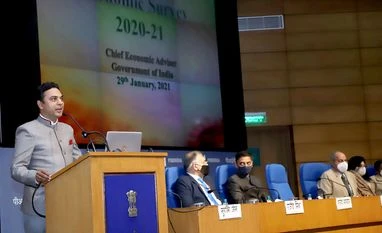
Chief Economic Adviser K V Subramanian on Saturday said the country would witness revival of 'animal spirits' of private enterprises with the economy staging a 'V-shaped' 11 per cent growth in the next fiscal year beginning April.
The Economic Survey 2020-21 presented in Parliament on Friday expects the growth rate to rebound sharply from an estimated record contraction of 7.7 per cent in the current financial year on account of the impact of the COVID-19 pandemic.
"I think next year with an 11 per cent growth rate, that is anticipated. Private sector moves in when they see opportunities," Subramanian said when asked about the revival of 'animal spirits' in private investment.
The expression 'animal spirits' was coined by celebrated economist John Maynard Keynes to refer to investors' confidence in taking action in terms of investment.
Subramanian, the lead author of the Economic Survey, also made a case for strong counter-cyclical measures to encourage private investment.
Observing that there are business cycles in the economy and there are peaks and troughs, he said, when the economy is doing really well, private sector is also doing very well and it's time for the government to step back and consolidate its fiscal position.
"But when the economy is not doing well, it's in a trough, the private sector therefore is not doing very well, the void that is left on consumption, investment etc, the government moves in and fills that void," he told PTI in an interview.
Most of the domestic companies have been shying away from making investments but rather busy in de-leveraging their books for the past few years. As a result, the responsibility of capital formation has largely fallen on the government's and state-owned firms' shoulders. Even during the pandemic, PSUs have undertaken capital expenditure (capex).
To encourage fresh investment from the private sector, the government in September 2019 cut corporate tax to one of the lowest in the world. In the biggest reduction in 28 years, the government slashed corporate tax rates up to 10 percentage points as it looked to pull the economy out of a six-year-low growth with a Rs 1.45-lakh crore tax break.
Base corporate tax for existing companies has been reduced to 22 per cent from 30 per cent; and from 25 per cent to 15 per cent for new manufacturing firms incorporated after October 1, 2019, and starting operations before March 31, 2023.
Emphasising the role of infrastructure spending in the economy, he said, these measures will reinvigorate demand in the economy.
That is why the government is emphasising on capital expenditure, especially infrastructure, he said.
"When infrastructure spending happens, that crowds in private investment. And that is why there is basically a jargon that for every rupee of public sector investment in infrastructure may be another rupee that comes in as investment from the private sector itself," Subramanian said.
The government is focussing on the National Infrastructure Pipeline which envisages an investment of Rs 111 lakh crore over five years.
He also highlighted that the government capital expenditure spending went up by 60 per cent in October on a month-on-month basis.
"It further increased to about 160 per cent in the month of November, and subsequently by another 60 per cent in December. So the capital expenditure spending we all recognise very well actually has much greater bang for the buck than revenue spending," he said.
The government's total capital expenditure for the current fiscal was pegged at Rs 4.12 lakh crore.
First Published: Jan 30 2021 | 4:40 PM IST

