Modi's financial inclusion plan to come in two phases
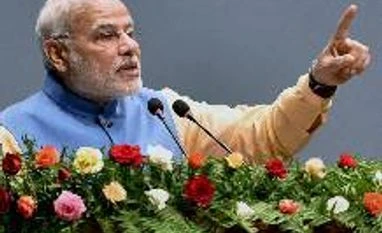
Vrishti Beniwal New Delhi The financial inclusion plan, announced by Prime Minister Narendra Modi on Friday is likely to be launched in two phases.
The first phase would comprise universal access to banking facilities. Under this, basic bank accounts with zero balance, RuPay debit card and financial literacy, will have to be completed in the next one year, officials said.
As the 'Pradhan Mantri Jan Dhan Yojana' was announced by Modi on his Independence Day speech, account opening camps would be launched from August 28, officials said.
In the second phase (August 2015-2018), micro insurance and unorganised sector pension schemes like Swavlamban would come along with the banking account. Officials said the inbuilt accident insurance cover of Rs 1 lakh, death insurance schemes would act as incentives for households to open a bank account.
"We are taking them towards some economic activity. Focus will be on online accounts and not on offline accounts as was the case earlier," one official said.
The programme will heavily rely on technology. As many as 75 million households that do not have access to banking services at present will be covered.
A minimum of one bank account will be opened per household, against the earlier proposal of two. As of now, 58 per cent households have access to banking facilities. The government was earlier targeting 100 per cent banking coverage but that might be difficult due to last-mile connectivity. Access to banking in areas with connectivity and infrastructure constraints will be provided in phase II.
An official said two accounts will be opened wherever it is possible to do that. However, about 50,000 villages are in forest or hilly areas. "There we have to find alternative solution. Telecom companies will expand to these areas with mobile facility," he said.
As Modi regretted that crores of families have mobile phones but do not have access to banking facilities, Finance Minister Arun Jaitley will launch a facility to allow mobile banking on all kinds of phones. These will include the basic ones which do not support internet or banking applications. USSD (unstructured supplementary service data) technology which works similar to SMS will facilitate this.
Since branchless banking in the form of business correspondents (BCs) is to be further expanded, minimum remuneration of BCs has been fixed at Rs 5,000. In the earlier campaign, there were no guidelines for remuneration of BCs but on an average they were getting around Rs 2,000-3,000.
"The earlier programme failed since the BCs were working on different technological platforms. We want interoperability," the official added.
There will be a lot more emphasis on fixed point BC. "Postal service staff and public distribution shops will be included as BCs," he said.
Microfinance institutions and non-banking financial companies (NBFCs), which are now eligible to operate as BC, are likely to play a key role in Modi government's scheme of things.
To incentivise banks, which had expressed concern that managing these accounts would increase their administrative costs, the government will transfer cash subsidies to the bank accounts of beneficiaries. Kerosene, liquefied petroleum gas, fertiliser, food, state-run schemes, wages, pension and many other subsidies will be transferred directly. These low-cost deposits will help improve CASA of banks. The government will also pay two per cent commission to banks on the money flowing in the accounts of beneficiaries.
About 700 million people have Aadhaar today, of which 270 million have bank accounts. Of this, only 70 million were covered in the last campaign of the UPA government. "In this round, we will link all the leftover Aadhaar numbers with bank accounts," the official said.

 "Modi's financial inclusion plan to come in two phases")


 Connect with us on WhatsApp