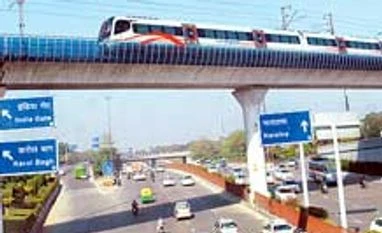
The pullout of Reliance Infrastructure-led concessionaire from the Airport Express Line of Delhi Metro, a showcase urban transport project, has once again put focus on public-private partnership (PPP) projects in India. Delhi Metro Rail Corporation (DMRC), which built the basic civil infrastructure, took over the operations of the Express line in public interest earlier this week. And, the private partner has slapped a penalty of Rs 795 crore on DMRC, setting the stage for a long-drawn legal battle between the two.
The fiasco surrounding the Rs 5,800-crore Express Line should, however, not come as a surprise. Neither the problems with the line nor the disputes between the partners are new. The project was mired in controversies from day one. Even before its commissioning in February 2011, the project was impacted by failed safety clearances and technical glitches and a tussle was on between DMRC and the Reliance Infra subsidiary, DAMEPL, over the issue of penalty for the delays. Post commissioning, severe glitches appeared in girders, forcing operations to close for six months. Operations finally resumed with Reliance running the line as an agent, paying DMRC a specific fee. The private operator has now claimed that fee, and the impact on its reputation, as penalty. All of this, with the country's first PPP project in railways.
A careful look at the main issues surrounding the Airport Express Line offers an understanding of the problems with India's 15 year-old PPP experience. One of the main factors for the failure of the Express Line PPP is an inflated traffic projection made in the beginning. While DAMEPL expected daily footfall to exceed 40,000, the actual footfall never crossed 20,000 per day. Even last week, before DMRC took over the line, the ridership was less than 11,000 per day. This skewed the projections of financial viability for the operator. So, does it make the private operator solely responsible for the problem? A section of stakeholders within the government says "yes". It is the duty of the private company to continue to meet the commitments originally made in the concession agreement without asking for contract renegotiation, they say.
Other experts disagree. Vinayak Chatterjee, chairman of Feedback Infrastructure Services, believes the notion that a PPP project would never have to face problems leading to contract renegotiation is the root of the problem with PPP in India. "In such large-sized projects, with commitments running into as many as 60 years, one should expect problems to occur right from day one. International experience shows that contract renegotiation should not be seen as a rare occurrence," he tells Business Standard. "No amount of human ingenuity can ensure nil problems over the 60-year life cycle of a PPP project," he adds.
Chatterjee argues that by getting in the vindictive mode in the face of problems with projects, the government forgets that the last 'P' of PPP stands for 'partnership'. This means that it is the duty of the public sector partner to assist the other partner in ensuring that capital invested sees a fair rate of return. "The problem lies in an ostrich-like belief that once negotiated, ground conditions will continue to hold forever; that the terms of the agreement between the private party and the state are cast in stone; and that any changes required can only attract charges of crony capitalism," Chatterjee says. "So, even while economists find it extremely difficult to predict growth and inflation for the next quarter, assumptions on project cost, traffic, tariff, input costs et al, that go into preparing a winning bid, are expected to be inviolate and unchanging."
* * *
When it comes to PPP, the country has invested the last decade-and-a-half in asset creation. So, a number of PPP concessions have been awarded in national highways and ports sectors. In the airports sector, private entities have developed metro airports at Bangalore, Hyderabad, Delhi and Mumbai through PPP concessions. In railways, the concessions for the operation of container trains have been awarded under PPP. According to a World Bank report on private participation in infrastructure, private participation in 2011 was highly concentrated in just one country - India. The report ranks India as the largest market for PPP in the developing world. India alone accounted for over half of the total investments in new PPP projects in developing countries in 2011, when it implemented 43 projects which attracted total investment of $20 billion. But this is only half the battle won.
The country has now entered an inflexion point in PPP where it is moving from asset creation to operation of projects. The shift is leading to problems in the absence of an institutional mechanism, like those present in other countries, to deal with renegotiations. There is suddenly a spate of PPP projects which have come up for renegotiation. GMR and GVK have walked out of recently-won mega-highway projects; the Gurgaon Expressway is in trouble and Delhi Airport has been shouting for resets. Adani Power and Tata Power are struggling to transform their imported coal-based projects into profit-making ventures on account of changes in input costs.
"The reasons for the failure of PPP projects in India are many, ranging from poor preparations, flawed risk-sharing, inappropriate business models and fiscal uncertainties to vested interests leading to development of skewed qualification criteria," says Dipesh Dipu, partner at consulting firm Jenisse Management consultants. No wonder the country has already entered a phase where PPP projects are increasingly running into issues. Interventions from regulatory bodies like Central Electricity Regulatory Commission and government agencies to make extra-contractual provisions to ensure projects continue to be implemented and operated in energy and infrastructure sectors are evidence of this phase.
* * *
So, where does the solution lie? One of the key elements of successful PPP projects is clear understanding of the proposed asset and prudent sharing of risks and rewards associated with the asset. Due to inaccuracies in these, the risk-sharing and mitigation measures prove inadequate and inappropriate, says Dipu. Most experts believe better preparation before the process of bidding for a PPP project is key. Technical data availability and its quality has been a serious constraint in several PPP projects in India. Ill-equipped consultants, selected through the lowest bid, may also be one of the root causes. When the contract becomes untenable and renegotiations within the given framework are unachievable, the parties are likely to part ways since no developer and not even government agency would like to bleed perpetually. "The cost of making a mistake in the planning stage is substantial, but in several such planning processes, we tend to focus on saving small and risking big," Dipu says.
Other experts believe it is not appropriate to shoot down the entire concept of PPP on the basis of one failure - that of the Airport Express Line. The nature of problems being faced by PPP projects varies from one project or sector to another. "One of the reasons for the problems with the Airport Express Line could be that construction and operation were done by two separate entities. This may have led to lack of integration. So, the lesson to learn is that design and construction risk should be properly taken care of on life cycle basis," says Abhaya Agarwal, partner and PPP leader at Ernst & Young.
Unlike railways, in roads, delayed clearances and aggressive bidding have emerged as two major factors causing problems. Additionally, with the economy not growing as projected earlier, traffic projections have gone wrong, leading to issues of financially viability. According to Agarwal, the recent problems with PPP projects have led to a slowdown in decision-making in the government regarding such projects. The government must address this problem by implementing such projects even more aggressively.

 "What is wrong with PPP in India?")


 Connect with us on WhatsApp