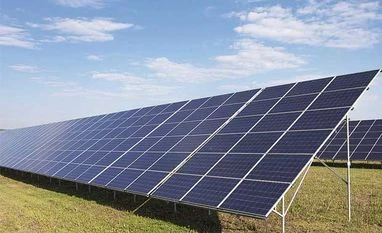
The government’s aim of 100,000 Mw solar power generation by 2022 hinges on the success of 33 solar energy parks with 19,900 Mw capacity being planned across 21 states.
Till recently, the upcoming 750 Mw park at Rewa in Madhya Pradesh was being touted as the biggest in the world. Now, say officials, Karnataka would have the biggest one, with 2,000 Mw capacity being planned at Pavagada in Tumakuru (earlier Tumkur) district. Some 3,000 Mw of solar park capacity has been implemented or is in the process of being tendered.
The term describes an area earmarked for development of solar power generation projects. It is generally expected to offer 500 Mw and above in capacity; officials said hilly states have been allowed to set up smaller parks, since getting contiguous land is a problem there.
“The solar park is a novel concept out of India. It can be replicated elsewhere through the International Solar Alliance,” said Ashvini Kumar, managing director, Solar Energy Corporation of India (SECI). It is the Union government’s nodal agency for developing this form of energy.
He says these are being set up under four models. One, the state government declares a designated agency for implementation. Two, a project is done in a joint venture with SECI. Three, implemented entirely by SECI. Four, states join hands with private developers.
SECI is involved with five of 33 solar parks, including the one coming up at Rewa. Maharashtra has two being implemented by private companies, KP Power and Pragat Akshay Urja. The Rajasthan government has decided on a tie-up with IL&FS Energy for development of 5,000 Mw of parks through an equal joint venture.
The first one is being implemented at Badla in Jodhpur district, for a capacity of 1,000 Mw. The JV has signed a lease agreement with the state for 2,400 hectares of government land. Connectivity approval to the grid has come from Rajasthan Raj Vidyut Prasaran Nigam for 500 Mw and Power Grid Corporation of India for 500 Mw.
“All long lead contracts are under finalisation. The company is in advanced discussion with many customers for development of power projects in the solar park. It would enable generation of 500 Mw by March 31, 2017, and a further 500 Mw by December 31, 2017,” said Sunil Wadhwa, chief executive officer, IL&FS Energy, Based on progress achieved in the first park, the JV would develop other parks in Rajasthan over the next four to five years, he said. The company is also in discussion with some other states to develop solar parks in multiples of 500 Mw capacity.
Solar parks help in advance action on two key enablers for solar power development -- land and power evacuation. Once these risk factors are taken care, what remains for project development and commissioning is more manageable. “These are clearly the long lead items and putting these in place means project developers are able to move from investment to power generation in six to nine months, as compared to around 15 months for standalone projects and with uncertainties related to land acquisition. The results are visible in the low tariffs (rates) recently bid for such projects to be set up in solar parks in Andhra Pradesh and Rajasthan,” said Wadhwa.
Under the solar park policy, land is provided by the state governments. Around 5 acres are required for one megawatt capacity, so Kumar said around 1 lakh acres would be required for the 33 solar parks all together. “If land is assured, the transmission network can be developed fast. Power is evacuated by state agencies,” said Kumar. Besides, wheeling charges for a line transmitting power till the central transmission line is not levied.
The land cost in solar parks, however, is higher than elsewhere, as project operators are offered developed infrastructure. Analysts fear this could lead to increase in final tariffs.
The Union government giving developers Rs 2 lakh for every Mw capacity as viability gap funding if being developed under the solar park policy. The developer recovers the remaining cost from project operators.
The Union government provides the guidelines for development, sets benchmarks and provides incentives. The ministry of new and renewable energy handles the other key area of coordination required for power evacuation, where Power Grid Corporation has been required to play a lead role in grid connectivity, said Wadhwa. Kumar said states want more parks to be developed and the Centre might look at expanding the programme.

 "Solar energy parks gain momentum")


 Connect with us on WhatsApp