
Goa breaks election records thanks to silent voters
Saturday's record breaking voting was nearly 21% higher than percentage posted during last Lok Sabha election in 2009, which was nearly 55%
 "Goa breaks election records thanks to silent voters")
WebinarsNew
Deep DiveNew
Explore Business Standard
Saturday's record breaking voting was nearly 21% higher than percentage posted during last Lok Sabha election in 2009, which was nearly 55%
Goa's record voting percentage Saturday has not only surprised politicians in Goa, but also sent pre-poll calculations haywire.
The 76.82% vote, a record for Goa as far as Lok Sabha polls here are concerned, has also given credence to the theory of a massive "silent vote"; something has put the fear of the devil amongst politicians.
Polling in Goa began on a brisk note Saturday morning. But when steady voting threatened to break the 15% barrier as early as 9 a.m., even Chief Minister Manohar Parrikar, who arguably has the most astute political mind in contemporary Goan politics, estimated a 70% voter turnout. He was nearly seven% off the mark.
Saturday's record breaking voting was nearly 21% higher than the percentage posted during the last Lok Sabha election in 2009, when nearly 55% of the eligible voters cast ballot.
The 76.82% voting record broke the more modest 1998 general election tally of 61%.
Parrikar was quick to appropriate the increased voting for his party, claiming the silent voter chosen the Bharatiya Janata Party (BJP).
"They are silent because they do not know you. We (politicians) understand it. When they smile at us, we know it is our vote," Parrikar said.
Former chief minister and Congress candidate from North Goa constituency Ravi Naik claimed the "silent voter" for himself, even revealing a 'trick', which according to him is a litmus test for identifying the instinct of a voter.
"You can see it when you meet them. The smiles they give you are enough of an indicator," explained Naik. The one, who smiles at you is someone who is going to or has voted for you, according to him.
In reality, neither any political party nor a candidate has anticipated the volume of voting before the election day.
Even the election campaigns organised by most of the political parties were lacklustre hardly evoking any popular response, which one is used to seeing in a typical vibrant Indian electioneering "tamasha".
"It was one of the most unattractive campaign. Its not that we did not try getting people to come and participate. The popular response just wasn't there. And it was the case with all parties," said a campaign manager of the BJP on the condition of anonymity.
For the record, the BJP trumped the Congress as well as the Aam Aadmi Party (AAP) as far as organisation and management of the pre-poll campaign is concerned.
But the huge contradiction between the lack of excitement generated during the election campaign and the tremendous, record-breaking voter response is one of the key reasons why political parties as well as journalists have begun to take the silent voter seriously in these polls.
A senior editor at a local cable news channel Ashley do Rosario claimed that the "silent voter" phenomenon has added a touch of unpredictability to the election and has put the fear of the devil in the top four candidates, two each from the Congress and the BJP, especially when there appeared to be no clear winners in the lot.
"We could have an element of surprise in the North Goa constituency result because of there is just too much of a contradiction. Even political parities like the Congress and the BJP do not really know what to expect, although they spout the usual bravado about 'winning confidently'," said Rosario.
The main contenders for the North Goa seat were sitting MP and BJP candidate Shripad Yesso Naik, Congress candidate Ravi Naik and Dattaram Desai from the AAP.
Aleixo Reginaldo from the Congress and BJP's Narendra Savoikar fought for the South Goa seat. The Congress party has won this seat in 10 out of 14 Lok Sabha elections.
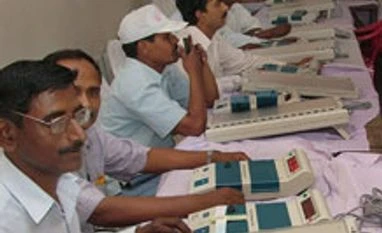
Whether the silent voter has spoken is an answer that can only unravel itself, when the votes polled in the electronic voting machines are decoded and winners are announced May 16.
First Published: Apr 13 2014 | 9:52 AM IST


 Connect with us on WhatsApp