A pre-poll reel feel, but Azamgarh loyalties lie with Akhilesh Yadav

There is hardly any doubt that despite the colourful Nirahua, it is Akhilesh Yadav who inspires confidence and respect
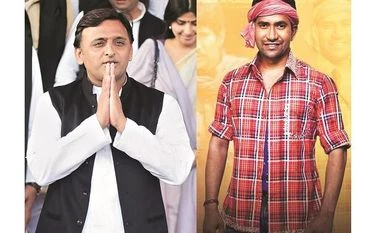
SP President Akhilesh Yadav & BJP's candidate Nirahua
SP President Akhilesh Yadav & BJP’s candidate Nirahua
Aditi Phadnis Azamgarh
5 min read Last Updated : May 08 2019 | 1:50 AM IST
In a perfect world, there would have been no contest: who’d have been brave enough to expect to win an election against the wildly popular, broodingly handsome, masterful hero of Nirahua Chalal London, (Nirahua travels to London)? This is the first Bhojpuri movie to be shot in London. Cash registers in movie halls in eastern UP and Bihar rang ka’ching non-stop when the film was released in February this year: to say it was a blockbuster would be an understatement.

Dinesh Lal Yadav Nirahua, the protagonist of the movie, is the Bharatiya Janata Party (BJP) candidate for the Azamgarh Lok Sabha constituency. All over the city, the signature lyric from the film is blaring on the roads: “Gori tohar kamar lachkauwa/ seedhe mare karejva mein ghauvva”. Loosely translated it means: ‘Darling, the way you move slays me’. The original is un-translatable. The song is shot against the backdrop of London Bridge and shows Nirahua and his buxom and curvaceous leading lady cavorting around the Big Ben as Brits pass by, staring at the couple. Nirahua is dressed in a turquoise jacket and purple trousers with a black and white muffler with checks. Just delicious.

But there’s no justice in the world. Nirahua is pitted against a formidable rival: Akhilesh Yadav, former Chief Minister of UP. Azamgarh is dominated by Yadavs: in the last 16 Lok Sabha elections, a Yadav has won 12 times from this constituency. It was Mulayam Singh Yadav’s constituency the last time around. This time, Akhilesh has claimed it.

When he addresses public meetings, Nirahua breaks into the ‘biraha’, a folk song, and the crowds, especially first-time voters, squeal, catcall and whistle. His biraha is about nationalism and the merits of Narendra Modi.

In a rally in Azamgarh on April 25, UP Chief Minister Yogi Adityanath said, “Once Azamgarh was known in the field of education and literature, but the SP turned it into a stronghold of terrorism and crime to defame it and we have come to pull it out of it...They (SP and BSP) have crime in their DNA and that is why they support cases like the Batla House encounter.”

But the Samajwadi Party (SP) musicians have their own riposte. Biraha singer Dharmendra Yadav’s YouTube video is viral. He reminds people via song (and Akhilesh Yadav’s picture in the background) that till last year, Nirahua was actually a member of the SP and there was nothing that the Akhilesh Yadav government had not given him, including the prestigious ‘Yash Bharati’ award instituted by the UP government. The biraha goes: ‘Akhilesh ke karni bhulaay gaila Nirahu/Modi ke godi me lukaay gaila Nirahu’ (forgetting all that Akhilesh did for him, Nirahu has jumped into Modi’s lap).

No one denies that much of infrastructural development of Azamgarh and surrounding areas was started when the Samajwadi Party was in power. However, much of it is incomplete. “We cry when we have to go to Varanasi. The distance is just 100 km — it should take 90 minutes. It takes three hours,” says Vijay Kumar Devvrat, editor of a local newspaper. The road was dug up three years ago. It remains dug up with the company contracted to build a new one, working fitfully and with lassitude — roadside piles of gravel and abandoned concrete plants are testimony to the slow pace of work. “The real torture is the rainy season,” Devvrat says. “Even more so when you consider the development in Varanasi, just next door.” The road is supposed to go from Varanasi to Sunauli on the Nepal border. No one knows when it will be ready.

This much is true: that Azamgarh has always been a bit a rebel and has paid for it. The tallest leader here was Chandrajit Yadav, Congress socialist and firebrand leader, at his height in the 1960s. He set up a sugar mill, which closed down and Akhilesh Yadav restarted it. But that is the only source of employment. All the cotton mills in this area are shut. As a result, there is massive migration to Mumbai, Delhi, Punjab and Gujarat with young people seeking any job that will pay them a living: as agricultural labour, dhaba wor­kers and daily wage workers on construction sites.

Which is why notebandi (demonetisation) represented such a terrible time — the worst ever, said a young man running a small eatery he started when he lost his job in Punjab. There is no village in Azamgarh that didn’t have at least 8 to 10 youths return home without a job. Those who managed to keep their job had to make do with massive cuts in pay — and the situation hasn’t returned to normal. Anil Kumar said, “I work in Mumbai in a tyre company. Only now, after two years, do I feel secure in taking 10 days off to come back home. On paper my salary is Rs 18,000. I actually get only Rs 8,000-9,000. After every 20 days, my employer gives me leave’. he has no work for me.”

Devvrat says the BJP must ponder why people in Azamgarh have the impression the BJP government at the Centre is not their government — and why Muslims, Yadavs and Dalits have now come together to overthrow it. Azamgarh has seen rare communal unity: the only time there was tension was in 1992 after the demolition of the Babri Masjid. In 2013-14, there was tension again, as a mob led by Yogi Adityanath went through the Muslim-dominated Takiya Mohalla, shouting inflammatory slogans. But even then, there was only curfew, no incidents.

Akhilesh Yadav put up a brand new collectorate building that cost almost Rs 33 crore. “What he completed is an asset. What he started and could not complete is still incomplete,” said Devvrat.

There is hardly any doubt that despite the colourful Nirahua, it is Akhilesh Yadav who inspires confidence and respect: as Azamgarh hopes, waits and prays for better times.

One subscription. Two world-class reads.

Already subscribed? Log in

Subscribe to read the full story →
*Subscribe to Business Standard digital and get complimentary access to The New York Times

Smart Quarterly

₹900

3 Months

₹300/Month

SAVE 25%

Smart Essential

₹2,700

1 Year

₹225/Month

SAVE 46%
*Complimentary New York Times access for the 2nd year will be given after 12 months

Super Saver

₹3,900

2 Years

₹162/Month

Subscribe

Renews automatically, cancel anytime

Here’s what’s included in our digital subscription plans

Exclusive premium stories online

  • Over 30 premium stories daily, handpicked by our editors

Complimentary Access to The New York Times

  • News, Games, Cooking, Audio, Wirecutter & The Athletic

Business Standard Epaper

  • Digital replica of our daily newspaper — with options to read, save, and share

Curated Newsletters

  • Insights on markets, finance, politics, tech, and more delivered to your inbox

Market Analysis & Investment Insights

  • In-depth market analysis & insights with access to The Smart Investor

Archives

  • Repository of articles and publications dating back to 1997

Ad-free Reading

  • Uninterrupted reading experience with no advertisements

Seamless Access Across All Devices

  • Access Business Standard across devices — mobile, tablet, or PC, via web or app

Next Story


