Lok Sabha elections: 1998 or 1996? BJP, state parties begin outreach

The BJP is conscious that the NDA, the coalition of 40 parties it leads, might fall short of the majority mark
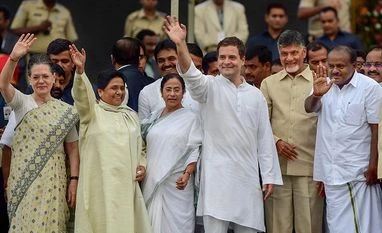
Opposition, UPA
Archis Mohan New Delhi
4 min read Last Updated : May 08 2019 | 1:19 AM IST
Elections to 424 seats in five phases are complete. Polling to only 118 seats is left, most of which are in states with multi-phase polling, which has helped the task of assessing eventual results easier.

While the Election Commission (EC) has banned putting in public domain exit poll data, most political parties have access to their internal surveys as well as such data, which has since the completion of the fifth phase of polling on Monday, spurred potential political alignments.

Two definite strands have emerged. One has a resonance to 1998, when the BJP, with 182 seats, formed a coalition government at the Centre, and the other is a throwback to 1996, when regional parties came together to form a government supported by the Congress and Communist Party of India (Marxist) from outside.

The Bharatiya Janata Party (BJP) is conscious that the National Democratic Alliance (NDA), the coalition of 40 parties it leads, might fall short of the majority mark.

BJP General Secretary Ram Madhav has admitted that the BJP could fall short of the majority mark, but expressed confidence that the NDA will cross the 272-mark. However, the BJP is not leaving anything to chance, if the NDA also falls short of the majority mark. In such a scenario, the BJP views Biju Janata Dal (BJD), YSR Congress and Telangana Rashtra Samithi (TRS) as potential allies.

On Monday, Prime Minister Narendra Modi spent several hours with BJD chief Naveen Patnaik. The PM and Patnaik, who is the Odisha chief minister, took an aerial survey to take stock of the damage in cyclone-hit areas in Odisha.

“The Naveen Patnaik-led government has done a commendable job in evacuating the coastal areas to avoid loss of lives,” Modi said later.

Elections to 21 of Odisha’s Lok Sabha and 147 Assembly seats ended on April 29. The BJP is also trying to woo YSR Congress chief YS Jaganmohan Reddy, but his demand for special category status for Andhra Pradesh would need negotiation in the coming days.

Meanwhile, efforts are also on to give shape to a ‘federal front’ comprising all the regional parties, including those who are part of the NDA.

TRS Chief K Chandrasekhar Rao met Kerala CM Pinarayi Vijayan on Monday. On Tuesday, Vijayan termed his meeting with Rao, who is the Telangana chief minister as well, a “significant one”. Vijayan, a CPI(M) leader, said regional parties in the country would play a major role in forming the government after the Lok Sabha elections. Rao and Vijayan held a two-hour closed-door meeting on Monday. Rao has been a votary of a non-Congress, non-BJP front, or a ‘federal front’. He had earlier found support from Trinamool Congress chief Mamata Banerjee. Even Nationalist Congress Party chief Sharad Pawar is said to be amenable to the idea.

“It was an important meeting. We discussed the national political scenario. According to his opinion, both the fronts may not get a majority in the polls. Hence, regional parties will play a major role,” Vijayan said.

He said the regional parties’ stand was to protect the rights of the states. “In our country, states are being sidelined by the Centre. There are many instances where the federal system of the country was undermined. The federal system must be followed. We need the Centre to stop taking decisions that affect the states,” Vijayan said.

The Kerala CM said Rao and him did not discuss anything about the prime ministerial candidate. He said the Lok Sabha results would bring down the BJP government at the Centre and the next government would protect secularism and the federal system of the country.

Rao also phoned Janata Dal (Secular) leader H D Kumaraswamy, who is also the Karnataka chief minister. Rao also plans to meet DMK chief M K Stalin.
 
According to Trinamool Congress sources, party chief Banerjee is in contact with some of the NDA constituents as well, including the Shiv Sena. Banerjee and Shiv Sena leaders had taken out a joint protest in Delhi against demonetisation in 2016. Opposition sources said Nitish Kumar-led Janata Dal (United) could also part ways with the BJP if a federal formation takes shape at the Centre.

On Monday, Bahujan Samaj Party chief Mayawati said she might contest from Ambedkar Nagar Lok Sabha seat to get elected to the Lok Sabha if she becomes prime minister. SP chief Akhilesh Yadav has already indicated he would support her for the prime ministerial chair. Bridges have been built in the last couple of days between the Congress and the BSP. 

The Opposition parties plan to meet in New Delhi on May 21, two days after polling ends and 48 hours before the counting of votes on May 23.

One subscription. Two world-class reads.

Already subscribed? Log in

Subscribe to read the full story →
*Subscribe to Business Standard digital and get complimentary access to The New York Times

Smart Quarterly

₹900

3 Months

₹300/Month

SAVE 25%

Smart Essential

₹2,700

1 Year

₹225/Month

SAVE 46%
*Complimentary New York Times access for the 2nd year will be given after 12 months

Super Saver

₹3,900

2 Years

₹162/Month

Subscribe

Renews automatically, cancel anytime

Here’s what’s included in our digital subscription plans

Exclusive premium stories online

  • Over 30 premium stories daily, handpicked by our editors

Complimentary Access to The New York Times

  • News, Games, Cooking, Audio, Wirecutter & The Athletic

Business Standard Epaper

  • Digital replica of our daily newspaper — with options to read, save, and share

Curated Newsletters

  • Insights on markets, finance, politics, tech, and more delivered to your inbox

Market Analysis & Investment Insights

  • In-depth market analysis & insights with access to The Smart Investor

Archives

  • Repository of articles and publications dating back to 1997

Ad-free Reading

  • Uninterrupted reading experience with no advertisements

Seamless Access Across All Devices

  • Access Business Standard across devices — mobile, tablet, or PC, via web or app

Next Story



