Common-sense banking
Aditya Puri has made HDFC Bank a financial powerhouse by keeping things simple. And his rural play is paying off handsomely
Somasroy Chakraborty Aditya Puri is the longest-serving head of an Indian bank, having joined HDFC Bank at its inception in 1994. The country's second largest private sector bank has benefitted hugely from what Puri calls "common-sense banking" - the bank's greatest strength is its ability to have the same quarterly consistency in terms of credit growth across credit cycles.
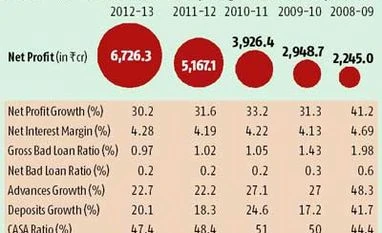
Under Puri, a graduate of Punjab University and a chartered accountant, HDFC Bank reported 30 per cent or more year-on-year growth in quarterly net profit. The trend was disrupted only during the second quarter of this financial year, when the bank's profit after tax increased by 27 per cent from a year earlier. But that is only to be expected in a year when the economy is under severe stress. The private lender continues to maintain a superior asset quality - the share of net non-performing loans in net advances was only 30 basis points at the end of September 2013. It has remained within this level since March 2010. The bank has been keeping its net interest margin in the range of 3.9-4.5 per cent for several quarters now, and has been growing its advances and deposits at a pace faster than the industry average.
Puri believes keeping things simple has ensured growth in the bank's profitability as well as its businesses. For instance, HDFC Bank never allows its retail customers to over-borrow, and refrains from lending to companies that have over-leveraged themselves.
HDFC Bank gets most of its funding from retail depositors (the share of low-cost current account savings account [CASA] deposits in total deposits is as high as 45 per cent), it sticks to its credit standards and pricing, and in general follows plain conservative banking.
At the same time, it is bold enough to conduct businesses that are perceived as 'risky' by its rivals. For instance, during 2008-09, when many foreign and Indian private banks exited or trimmed their credit card businesses, fearing deterioration in asset quality, HDFC Bank continued to grow its credit card base. It did not affect the asset quality, as the bank has always been offering the bulk of its credit cards to customers with whom it has already established other banking relationships. Currently, the bank is the largest issuer of credit cards in the country, with a base of over five million cards.
When it comes to inorganic growth opportunities, the bank is probably one of the most aggressive players in the country. In 2000, HDFC Bank acquired Times Bank, and eight years later it went on to buy Centurion Bank of Punjab.
But experts say Puri and his team's biggest contribution has been in its aggressive expansion into rural areas, when no one thought it was a feasible proposition. Almost half of its network of over 3,200 branches is in semi-urban and rural areas, up from 34 per cent three years ago. The bank aims to raise this number to 60 per cent in the next three years. Lending in these villages and small towns expanded as much as 40 per cent in the past two years. What helped was the acquisition of Centurion Bank of Punjab which, Puri says, gave the bank a product range that was more suited to rural and interior areas. Today, 56 per cent of HDFC Bank's distribution outlets are in semi-urban and rural areas, but only 15 per cent of its income comes from these areas. The bank expects the income number to go up to 50 per cent in five years.
And the bank has worked hard on changing the distribution, sales, back-office and the mindset for a market that the bank thinks offers one of the biggest opportunities available in the globe today. For example, the bank's Sustainable Livelihood Initiative (SLI) engages women by aiming to make them financially independent. It provides occupational training, financial literacy, credit counselling, livelihood finance and market linkages to women in the rural areas that are mainly unbanked or underbanked. HDFC Bank aims to make 50 million women economically independent. Under the SLI programme, which was started about three years ago, the bank has so far disbursed loans to the tune of Rs 2,500 crore. More importantly, the bank believes such a programme is a viable business proposition in the long run, and it will expand the loan amount depending upon the capacity of the people taking such loans.
The overall business model of the bank has been pretty straightforward: never let a retail customer over-borrow, and don't lend to companies that have over-extended themselves.
HDFC Bank's growth and Puri's work-life balance (he does not use a mobile phone, doesn't wear a watch, leaves office at 5:30 pm sharp, prefers to grow vegetables at his Lonavala farmhouse and spend time with his daughter during weekends) has made him a role model for chief executives of many Indian and foreign banks. Some of them even aim to replicate the 'HDFC Bank model' in their respective banks, and are not shy of admitting it publicly.
Puri may have perfected the art of optimising leisure, but HDFC Bank and its customers aren't complaining.

 "Common-sense banking")


 Connect with us on WhatsApp