Operational strength, subsidiaries to drive State Bank of India's re-rating

Annual operating profit of Rs 60,000 crore good enough to absorb any increase in provisioning, while high growth potential subsidiaries to drive valuations
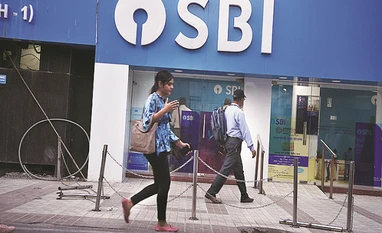
SBI
Overall, even after the 14 per cent gains in the past one week, the risk-reward for SBI remains favourable. Long-term investors may look for a correction for a better entry point.
Vishal ChhabriaShreepad S Aute Mumbai
4 min read Last Updated : Sep 05 2020 | 12:05 AM IST
Brokerages, both foreign and domestic, recently raised their rating on SBI with a target price of up to Rs 310, indicating potential upside of 50 per cent from the present Rs 207.

SBI’s ability to generate strong operating profit, a strong balance sheet (B/S), and strong growth potential of subsidiaries justifies the re-rating potential, even though it comes when the banking system is exposed to asset quality risk. 
Nitin Aggarwal, analyst at Motilal Oswal, says: “Besides lower funding costs (led by falling deposit rates), market share gains — both in advances and deposits —along with digital capabilities will help SBI maintain strong momentum in pre-provisioning operating profit (PPOP).”

“Even if bad loans rise on account of the Covid-led slowdown, SBI’s operating profit will keep it in good stead, to offset an increase in provisions,” said a fund manager at a domestic fund house.

In the last four years, SBI has posted average annual PPOP (excluding Rs 35,000 crore of cumulative trading income) of Rs 50,000 crore, which has helped absorb maximum loan loss provisions. Rising leverage and focus on digitisation should also help lower its higher cost-to-income ratio.


Additional support will stem from unrealised investment gains, which could account for 18 per cent of SBI’s loan loss provisioning requirement over the medium term, said Goldman Sachs in a recent report. SBI is also better placed in terms of asset quality. A large chunk, or close to 60 per cent of SBI’s loans, is to public-sector unit employees, while 60-95 per cent of retail advances are to PSU staff.

CLSA analysts, led by Adarsh Parasrampuria, say: “SBI is better positioned than peers in terms of Covid impact on asset quality, as its share of government/PSU staff is disproportionately large.”

A B/S clean-up in the corporate segment in FY18 offers more comfort. The SBI management, during its June quarter analysts’ call, had indicated a slippage ratio of 1.5-1.6 per cent in FY21 in the base case due to Covid-19, lower than over 2 per cent in FY20.

Provisioning coverage ratio (PCR) of 86.3 per cent for the June quarter was also among the highest, and its capital position (tier-1 ratio of 11.4 per cent) fared better.

Consequently, many analysts foresee improvement in the valuation of SBI’s core banking franchise, which was very low.

SBI’s investment across subsidiaries and YES Bank is worth Rs 1.50 trillion. Excluding this from its m-cap of Rs 1.84 trillion, the residual value of Rs 34,000 crore for SBI’s banking business is lower than Bandhan Bank’s market cap of Rs 50,573 crore, IndusInd Bank’s Rs 42,703 crore, and YES Bank’s Rs 35,753 crore.


While part of the holding company discount (15-20 per cent) may apply to investments in subsidiaries, these businesses have grown well prior to Covid-19, and are expected to sustain the healthy growth.

CLSA says subsidiaries (SBI Cards, SBI Life, and SBI Mutual Fund) are the best-in-class in their segments. These have grown at a CAGR of 25-40 per cent since five years, driven by SBI’s distribution strength. Their contribution also ensures that capital raising by SBI is not book-dilutive. Overall, risk-reward for SBI remains favourable. Long-term investors may wait for a correction before entry.

Among downside risks include a prolonged slowdown, significant stress at YES Bank, and sharper-than-expected slippage of restructured assets into bad loans. 

Lalitabh Srivastava, deputy vice-president at Sharekhan, says: “We don’t see major downside risks from the Supreme Court order. While restructuring will help realign exposures, SBI’s robust PCR and operating metrics offers strong comfort.”

One subscription. Two world-class reads.

Already subscribed? Log in

Subscribe to read the full story →
*Subscribe to Business Standard digital and get complimentary access to The New York Times

Smart Quarterly

₹900

3 Months

₹300/Month

SAVE 25%

Smart Essential

₹2,700

1 Year

₹225/Month

SAVE 46%
*Complimentary New York Times access for the 2nd year will be given after 12 months

Super Saver

₹3,900

2 Years

₹162/Month

Subscribe

Renews automatically, cancel anytime

Here’s what’s included in our digital subscription plans

Exclusive premium stories online

  • Over 30 premium stories daily, handpicked by our editors

Complimentary Access to The New York Times

  • News, Games, Cooking, Audio, Wirecutter & The Athletic

Business Standard Epaper

  • Digital replica of our daily newspaper — with options to read, save, and share

Curated Newsletters

  • Insights on markets, finance, politics, tech, and more delivered to your inbox

Market Analysis & Investment Insights

  • In-depth market analysis & insights with access to The Smart Investor

Archives

  • Repository of articles and publications dating back to 1997

Ad-free Reading

  • Uninterrupted reading experience with no advertisements

Seamless Access Across All Devices

  • Access Business Standard across devices — mobile, tablet, or PC, via web or app

Topics :sbiRajnish KumarSBI stockSBI CardsSBI LifeSBI Mutual Fund

Next Story



