The 5.6-magnitude quake that hit Indonesia's Cianjur region resulted in the deaths of 271 persons, however, the hopes for survivors persist after a six-year-old boy was pulled alive from the wreckage of a property on Wednesday after surviving for more than two days under debris.
The rescue effort brings hope to those waiting for news of loved ones after a powerful earthquake struck a populated area of Indonesia's West Java province, reported CNN.
Indonesia's National Agency for Disaster Management (BNPB) said rescuers saved Azka Maulana Malik in the village of Nagrak, in Cugenang subdistrict, Cianjur Regency. Footage showed the moment a rescue team found him.
The agency said that the boy was discovered next to his grandmother's body. Azka is now being treated in Cianjur hospital, local media reported. Rescuers had taken out his parents' bodies earlier, the agency added.
The 5.6-magnitude quake hit the Cianjur region in West Java at about 1:21 p.m. local time on Monday at a depth of 10 kilometres (6.2 miles), according to the United States Geological Survey (USGS), causing buildings to collapse while school classes were underway.
The death toll from the earthquake has risen to 271, the head of the BNPB, Maj Gen Suharyanto, said at a press conference. More than a third of those confirmed dead are children, he said, reported CNN.
Some 2,043 people were injured and 61,800 have been displaced, he added. Forty people remain missing.
Suharyanto said 56,320 houses were damaged, more than a third of them badly. Other damaged buildings included 31 schools, 124 places of worship and three health facilities.
The agency has built 14 refugee shelters with facilities for displaced people, Suharyanto said. Victims are expected to leave their temporary tents and move to these main shelters, he said.
According to Suharyanto, BNPB deployed more than 6,000 rescuers to search-and-rescue operations, reported CNN.
The scale of the death and destruction caused by the quake became increasingly clear on Tuesday, after earlier discrepancies in the casualty numbers reported by officials.
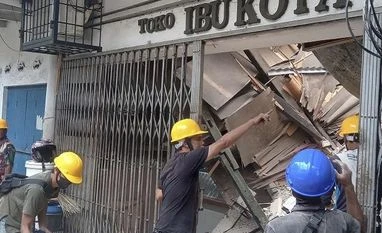
Photos showed buildings reduced to rubble, with bricks and scraps of broken metal strewn on the streets.
"So many incidents occurred at several Islamic schools," West Java Governor Ridwan Kamil told reporters Monday, as he warned that many of those killed were children, reported CNN.
The powerful tremors forced children to flee from their classrooms, according to aid organization Save the Children, which said more than 50 schools had been affected.
Mia Saharosa, a teacher at one of the schools, said the earthquake "was a shock to all of us," according to the organization.
Herman Suherman, a government official in Cianjur, told the media that some residents were trapped in the rubble of collapsed buildings. News channel Metro TV showed what appeared to be hundreds of victims being treated in a hospital parking lot.
Visiting areas affected by the quake on Tuesday, Indonesian President Joko Widodo said the government would provide compensation of up to about USD 3,200 each for owners of heavily damaged homes, reported CNN.
Houses should be rebuilt as earthquake-resistant buildings, he added.
Indonesia's bureau of meteorology, the BMKG, warned of a danger of landslides, particularly in the event of heavy rain, as 25 aftershocks were recorded in the first two hours after the quake.
Indonesia sits on the "Ring of Fire," a band around the Pacific Ocean that sets off frequent earthquakes and volcanic activity. One of the most seismically active zones on the planet, it stretches from Japan and Indonesia on one side of the Pacific to California and South America on the other.
In 2004, a 9.1 magnitude quake off Sumatra island in northern Indonesia triggered a tsunami that struck 14 countries, killing 226,000 people along the Indian Ocean coastline, more than half of them in Indonesia.

 "Indonesia quake: 6-yr-old pulled alive from wreckage, death toll at 271")


 Connect with us on WhatsApp