Prime Minister Narendra Modi today met Palestinian President Mahmoud Abbas on his historic visit to Palestine and the two sides signed agreements worth around USD 50 million that includes setting up of a USD 30 million super speciality hospital.
President Abbas received Prime Minister Modi in an official ceremony at the presidential compound, also known as Muqata'a, in Ramallah - the Palestinian seat of government.
Modi is the first Indian Prime Minister to make an official visit to Palestine.
After their talks, Prime Minister Modi said he has assured President Abbas that India is committed to the Palestinian people's interests.
He said India hopes for the return of peace in this region.
"We know that it's not easy, but we should keep striving because a lot is at stake," he said in a joint press conference with President Abbas.
On his part, President Abbas acknowledged that the Indian leadership has always stood by peace in Palestine.
Abbas said Palestine is always ready to engage in negotiations to achieve its goal of an independent state. He asked India to facilitate the peace process with Israel.
"We rely on India's role as an international voice of great standing and weigh through its historical role in the Non-Aligned Movement and in all international forum and its increasingly growing power on the strategic and economic levels, in a way that is conducive to just and desired peace in our region," President Abbas.
The two sides signed agreements worth USD 50 million. The agreement includes setting up of a super speciality hospital worth USD 30 million in Beit Sahur and construction of a centre for empowering women worth USD 5 million.
Three agreements in the education sector worth USD 5 million and for procurement of equipment and machinery for the National Printing Press in Ramallah were also signed.
President Abbas also conferred the 'Grand Collar of the State of Palestine' on Prime Minister Modi, recognising his key contribution to promote ties between India and Palestine.
The Grand Collar is Highest order given to foreign dignitaries - Kings, Heads of State/Government and persons of similar rank.
Earlier, the two leaders exchanged hugs and stood for the national anthem of the two countries and then inspected the guard of honour before their bilateral talks.
Archbishop of Catholic Church, Poulos Marcwas, and religious leaders of the Al-Aqsa mosque were also at the Muqata'a to greet Modi.
Modi flew in a Jordanian army helicopter straight from Amman to Ramallah, where he was received by his Palestinian counterpart Rami Hamdallah. Prime Minister Modi's chopper was escorted by choppers from Israel Air Force.
"This is a historic visit that will lead to stronger bilateral cooperation," Modi said shortly after landing.
Soon after his arrival, Prime Minister Modi visited the Mausoleum of Yasser Arafat in Ramallah and laid a wreath at the grave of the iconic Palestinian leader. He was accompanied by his Palestinian counterpart Hamdallah.
The mausoleum was unveiled on November 10, 2007 and is located adjacent to the Palestinian Presidential compound, also known as Muqata'a here.
After paying homage to Arafat, Modi took a short tour of the Arafat Museum located adjacent to the mausoleum.
During his maiden visit to Israel last year, Modi did not travel to Ramallah. His standalone visit to Israel had led to analysts questioning the future of the Indo-Palestine ties.
This time Modi skipped Israel in a clear message that India is de-hyphenating its ties with Israel and Palestine.
Modi's visit to Palestine comes amid heightened tensions in the region after US President Donald Trump recognised Jerusalem as the capital of Israel.
The unilateral US decision to declare Jerusalem as the capital of Israel was challenged at the UN General Assembly where 128 nations, including India, voted to turn down the move as "null and void".
Trump's decision to declare Jerusalem as Israel's capital angered the Palestinians, sparked protests in the Middle East and raised concern that it could further destabilise the region.
Though India has shied away from becoming a party in the Israel-Palestinian conflict, the Palestinian leader on several occasions has stressed on a possible role for New Delhi in the Middle East peace process.
India believes in a two-state solution in which both Israel and a future Palestinian state coexist peacefully.
The two-state solution envisions independent Israeli and Palestinian states coexisting side by side peacefully. The Palestinians see east Jerusalem as their future capital.

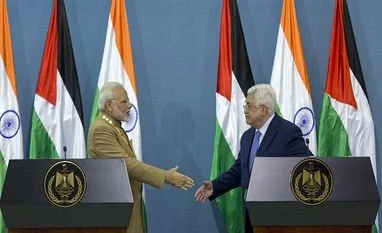 "PM Modi meets Palestine President Abbas; deals worth $50 million signed")


 Connect with us on WhatsApp