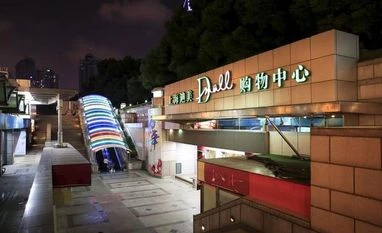
The Di Mei shopping centre in downtown Shanghai is a surprisingly depressing place to shop.
The underground mall is located in one of the most shopping-mad cities in China, and yet it is run down and starved of customers.
"Sometimes I cannot sell even one dress in a day," said dress shop owner Ms Xu, who rents a space in Di Mei.
Rising vacancy rates and plummeting rents are increasingly common in Chinese malls and department stores, despite official data showing a sharp rebound in retail sales that helped the world's second-largest economy beat expectations in the third quarter.
The answer to that apparent contradiction lies in the rising competition from online shopping and government purchases possibly boosting retail statistics. Add poorly managed properties into the equation and the empty malls aren't much of a surprise.
More importantly, the struggles of Chinese brick-and-mortar retailers amplify a policy conundrum; these malls, built to reap gains from rising consumption, are instead adding to China’s corporate debt problem, currently at 160% of GDP - twice as high as the United States.
Less foot traffic means cash flow of mall owners and developers are getting squeezed - a potential hazard for an economy growing at its slowest pace in decades.
Di Mei's owners are trying to refurbish, but it's unclear whether it will pay off, and others are just closing down. The Sunlight Store in Beijing, for example, is located in another prime pedestrian hub, but it closed its blinds this month, with manager Ni Guifang telling Reuters they are seeking greener pastures online.
"The sales were just OK, but the overall sales were on the downward trend," Ni said.
TRIMMING DOWN
Major listed mall operators are also feeling the pain. Dalian Wanda, a big property developer, said in January it would close or restructure 30 of its retail venues and in August said more adjustments were underway.
Malaysia-based Parkson, which operates more than 70 department stores in China, closed several of its stores in northern China last year following a 58% drop in China net profit in 2013.
"As growth in retail sales slows because of the country's lower GDP growth, and in cities where mall space is abundant, vacancy rates have risen substantially," said Moody's analyst Marie Lam in a research note.
In its latest efforts to re-energise the economy, China's central bank on Friday cut interest rates for the sixth time in less than a year.
Tim Condon, an economist at ING in Singapore warned that investors should not read China's official retail figures as exclusively reflective of rising household consumption, noting that the data also capture some government purchases.
On the other hand, e-commerce sites continue to post double-digit growth rates, even as some moderation is evident. E-commerce leader Alibaba is expected to report that sales growth slowed sharply in the second quarter - albeit to around 27% on-year, still a ripping pace.
And as more Chinese graduate to the ranks of the middle class, places offering entertainment are thriving. Movie ticket sales hit a new record of nearly $300 million during a single holiday week in October, up 60% year-on-year.
But this is little consolation for the likes of Di Mei. And the risk is that the frenetic pace of mall construction cascades into a bad-debt problem for banks if shoppers fail to match the zeal of property developers.
SHOPPING OVERCAPACITY
China is currently the site of more than half the world's shopping mall construction, according to CBRE, a real estate firm, even though it appears that many of these malls will not produce good returns for their investors.
A joint report by the China Chain Store Association and Deloitte showed that by the end of this year, the total number of China's new malls is projected to reach 4,000, a jump of over 40% from 2011.
Real estate analysts note that much of the surge in retail space construction came at the behest of local governments, who were rushing to push real estate development as part of attempts to stimulate the economy. The result has been malls built in haste and managed poorly.
Not surprisingly, shoppers are voting with their feet.
"If you build it and they're not coming, that's a non-performing loan," said Condon of ING.
"That's the banks' problem."
($1 = 6.3455 Chinese yuan)

 "Why are malls closing in China if consumption is rising?")


 Connect with us on WhatsApp