Recently (January 19, 2018), the last ICF coach was flagged off and pictures appeared in the media. It was flagged off by P Bhaskar, a senior technician, with Ashwani Lohani (Chairman, Railway Board) present. A lot of stuff appears in the media and must be taken with several pinches of salt. For instance, at the time of this event, there was a media report that the first ICF coach was flagged off on October 2, 1955, by then Prime Minister and Railway Minister Jawaharlal Nehru. The date is right, but nothing else. Lal Bahadur Shastri resigned as railway minister (minister of railways and transport) in September 1956 (the resignation was accepted later). In 1955, he was railway minister and the first machine at the ICF plant was commissioned by Lal Bahadur Shastri on January 20, 1955. On October 2, 1955, in Lal Bahadur Shastri’s presence, Jawaharlal Nehru didn’t quite flag off an ICF coach. He inaugurated the shell division, so October 2 is like a birthday for the ICF (Integral Coach Factory, Perambur). He couldn’t have flagged off a coach. They weren’t ready. A shell is the skeleton for a coach, like chassis for a vehicle. Furnishings are added later. Before ICF, the shell used to be separated from the under-frame. With a single shell body, ICF made it integrated.
Reports will suggest before ICF, coaches were wooden. ICF changed that to steel. That’s only partly true. Under-frames switched to steel earlier. But yes, shells were wooden. N Gopalaswami Ayyangar, in his railway budget speech on February 23, 1949, said, “The House will remember the Silver Arrow model train which was exhibited round India in 1947. Many enquiries have since been received as to when stock of that kind could be seen on Indian Railways. Progress has been made in manufacturing the all-metal light-weight type coach in India... The Railway Board has been examining the possibility of establishing for Indian Railways a Central Coach Manufacturing Workshop where such all-metal light-weight coach construction could be done with a view to adding to indigenous capacity in this sphere. For this workshop also, as in the case of locomotives manufacture, the Railway Board is considering the question of obtaining technical aid from foreign manufacturers with years of experience of welded all-metal coach building.” Evidently in 1947, “Silver Arrow”, branded and exhibited as a concept “train of the future”, was quite a hit.
Safety Coach: A technological gap was bridged when Indian Railways started to manufacture Linke-Hofmann-Busch design coaches for Shatabdi and Rajdhani Express trains
Swiss Car and Elevator Manufacturing Company, based in Schlieren (Zürich), was established in 1885 to manufacture rolling stock. (After one hundred years, it closed down in 1985.) There was an International Railway Congress (in Lucerne) and that showcased Swiss railways. (1947 was the Centenary Year of Swiss Federal Railways.) Thus, IR (Indian Railways) zeroed in on the Swiss company and an agreement was signed on October 2, 1953, for technology transfer. Initially, there was expected to be an annual production of 300 shells, later increased to 350. But as I said, on October 2, 1955, there were no shells to flag off. The first seven coaches (third class) were imported and assembled in 1955-56. These were flagged off in February 1956, while the first fully indigenous one had to wait till August 1956. Walter Braem was CEO of the Indian arm of the Swiss company and on the net, you will find a touching account of his grandson, Lukas Baumann, visiting Perambur in 1996. In 2015, the diamond jubilee year, ICF completed a cumulative total of 50,000 coaches (of various types). Annual production inched up from the initial 350, and in 2016-17, almost 2,300 coaches were produced.
Technology changes. There is a difference between railway accidents and fatalities because of accidents. Cross-country, IR’s accident record isn’t that bad. The fatality numbers should be far better and a switch from ICF to LHB (which are safer) was inevitable. But in their day, ICF coaches also reduced fatalities, especially for head-on collisions. For instance, on October 5, 1979, in Faridabad, there was a collision between a Delhi-Palwal shuttle train and a goods train. The report of the resultant Enquiry Commission was critical about usage of non-ICF coaches. “With a large number of ICF coaches available on the train formation this wooden-bodied coach should not have been marshalled second from the engine.” While on accidents, the Khanna disaster in 1998 signalled the end of the ICF era (apart from flagging quality of rails), though it took time for it to finally happen. In 2012, the High Level Safety Review (Anil Kakodkar) Committee said, “The Committee has therefore recommended to stop production of ICF design coaches and completely switch over to manufacture of LHB design coaches immediately… Though ICF shell is designed to be anti-telescopic, however, the screw coupling is a design limitation as this out beats the concept of anti-telescopic feature of the coach as a whole… This technological gap was bridged when IR started to manufacture LHB Design Coaches at RCF Kapurthala, for Shatabdi and Rajdhani Express trains fit to run at high speeds 130-150 kmph.” Note what this says about anti-telescopic features of LHB being nullified by screw coupling. Without that and at lower speeds, ICF’s performance wouldn’t have been that dismal.
LHB (Linke-Hofmann-Busch) coaches perform better and not just on safety. The first order for LHB coaches was given in 1995 and the first LHB coaches were imported in 1999. The LHB technology is also about 30 years old, though ICF was almost 70 years. The author is chairman, Economic Advisory Council to the Prime Minister. Views are personal

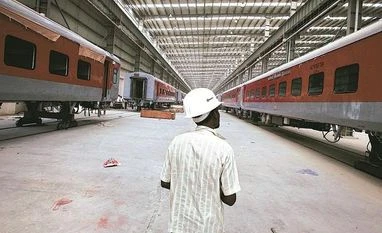 "A 70-year-old vs a 30-year-old: LHB coaches perform better than ICF ones")












 Connect with us on WhatsApp