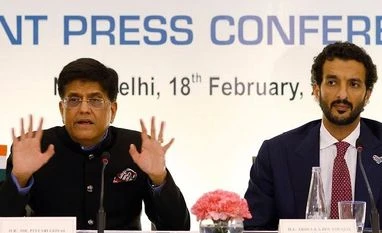
The announcement of a trade deal between India and the United Arab Emirates (UAE) cannot come as a complete surprise, as officials have been saying for some time that negotiations —although they were officially started only in September 2021 —have been proceeding quickly. Yet the fact is that this is a major step forward in that it is the first new trade agreement signed since Prime Minister Narendra Modi took office in 2014. For most of this government’s tenure, it has been noticeably reluctant to move India’s trading relations forward. Most notably, it withdrew from the Regional Comprehensive Economic Partnership (RCEP) shortly before that giant trade deal was to be signed. But the UAE trade deal, being called a comprehensive economic partnership agreement, or CEPA, is being sold as one of a set of such agreements that will mend the image of the government, which was heretofore seen as having turned inwards in matters of trade. The country is India’s third-largest trade partner, with its ports, especially Jebel Ali, serving as major trans-shipment hubs for Indian trade. This explains why claims are being made, including by ministers, that it opens up trade to Africa as well.
Certainly, it must be seen alongside large-scale attempts by UAE-based companies to create markets for goods, including Indian goods, within the new African free trade area. Aspects of the CEPA are clearly of interest. For one, it includes regulatory aspects, which India has never been a big fan of, including in trade deals although they have become commonplace worldwide. On this occasion, the UAE has agreed that pharmaceutical products produced in India that have cleared regulatory processes in high-capacity administrative states in the Western world will receive time-bound approvals in the Emirates. Similar questions tend to be raised in New Delhi about trade deals that include opening up government procurement, but the CEPA allows for companies in one country to bid for state contracts in the other. It is also the UAE’s first trade deal, and some argue that it might be a prelude to a broader agreement between India and the countries of the Gulf Cooperation Council, or GCC.
Yet significant questions remain. Worries that trade will harm domestic producers continue to animate some Indian policymakers, reflected in the assurances built into the CEPA that high imports will mean that safeguards can be set up. Indian officials have stressed that the CEPA will favour labour-intensive sectors in India, hoping no doubt that it will mean that export-linked jobs will grow. Yet there is no alternative, if job growth is the end, to embedding India more firmly in global value chains. It is not clear how far the CEPA will go in enabling this transition. Certainly, it does not counteract the negative effects of choosing to sit out the RCEP. The larger question is how the remaining deals on New Delhi’s plate —limited though they are, and focused on Western partners —will help integrate Indian producers with supply chains. Swifter regulatory shifts within India and harmonisation with procedures elsewhere must be the priority. It is too soon yet to declare that New Delhi’s attitudes to trade have shifted, but certainly there are more grounds for optimism now.

 "A good start")












 Connect with us on WhatsApp