How safe are India's dams?

The long-term safety of a dam depends on the extent of degradation of its materials, weakening of the foundations and seismological threats
chart
Vinayak Chatterjee
5 min read Last Updated : May 04 2022 | 10:45 PM IST
On August 11, 1979, after a week of extraordinary monsoon rains in Gujarat, the two mile-long Machhu Dam-II disintegrated. The waters released from the dam’s massive reservoir rushed through the heavily populated downstream area, devastating the industrial city of Morbi and its surrounding agricultural villages. Bridges gave way, factories crumbled, and thousands of houses collapsed. While no firm figure has ever been established on the disaster’s final death count, estimates have run as high as 25,000. Despite the enormous scale of the devastation, few people today remember this terrible event. The book No One Had A Tongue To Speak by Tom Wooten and Utpal Sandesara debunked the official claims that the dam failure was an act of God and pointed to structural and communication failures that led to and exacerbated the disaster. 

Other notable dam failures in India include Kaddam (1957), Panshet (1961), Khadakwasla (1961) Chikkhole (1962) and Nanak Sarar (1967). More recently, in early February 2021, an area of Chamoli district in Uttarakhand was devastated, and 140 lives lost, when a Himalayan glacier broke off and caused a high velocity surge of water down a river sweeping away one dam in its path and damaging another. Jal Shakti Minister Gajendra Singh recently told the Rajya Sabha that since 1979, there were 42 instances of dam failures, the latest being the Annamayya reservoir in Kadapa district of Andhra Pradesh that led to the death of at least 20 people in November 2021.

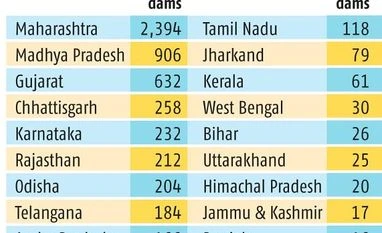
India has the third largest number of dams in the world at 5,745, following China with 23,842 and the US with 9,261. The dams are also located across the length and breadth of the country (see table). The point of concern is that 80 per cent of the dams are more than 25 years old, and with the accumulated burden of deferred maintenance, many have huge associated risks. Adding to this age-stress is that 293 dams (6 per cent) are more than 100 years old and 973 (18 per cent) are 50-100 years old.
The long-term safety of a dam depends on the extent of degradation of its materials, weakening of the foundations and seismological threats. The physical rehabilitation of dams involves two clear streams of activity. The first is “de-siltation” — to restore the original reservoir capacity. The second is “safety” — encompassing, structural safety, hydrologic safety and operational safety. 

The issue of dam decommissioning also needs to be brought into the action-agenda. Demands for decommissioning have already been raised for the Mullaperiyar dam in Kerala, Dumbur dam over the Gumti river in Tripura and Jayakwadi dam in Maharashtra in different contexts by civil society groups and independent experts. The Supreme Court ruled on April 8 that a Supervisory Committee for the 126-year old Mullaperiyar dam shall discharge all the functions and powers of the National Dam Safety Authority until a regular national authority becomes functional under the Dam Safety Act, 2021.

The Dam Safety Organisation (DSO) was established in the Central Water Commission (CWC) in May 1979 to convince the states about dam safety. Issues related to dam safety have often been cited in reports of the Comptroller and Auditor General. The efficacy of the DSO has also been questioned in such reports.

The first major programme initiated was the Dam Safety Assurance and Rehabilitation Project implemented with support from the World Bank from 1991 to 1999 at a cost of ₹423 crore in four states (Madhya Pradesh, Odisha, Rajasthan and Tamil Nadu). The second programme was the World Bank funded Dam Rehabilitation and Improvement Project (DRIP), from April 2012 to March 2021 with a much larger budget outlay of ₹3466 crore. This scheme has rehabilitated 223 dams located in seven states — Jharkhand, Karnataka, Kerala, Madhya Pradesh, Odisha, Tamil Nadu and Uttarakhand. Based on the success of DRIP, the Ministry of Jal Shakti has initiated DRIP Phase II and Phase III. These new schemes have 19 states, and three central agencies (Bhakra Beas Management Board, CWC and Damodar Valley Corporation) on board. The budget outlay is substantial at ₹10,211 crore with rehabilitation provision of 736 dams.

The Dam Safety Bill, 2019, was passed by the Lok Sabha on August 2, 2019. This legislation provides for surveillance, inspection, operation and maintenance of specified dams by the establishment of a National Committee on Dam Safety, National Dam Safety Authority, State Committee on Dam Safety, and the State Dam Safety Organization. The Bill was opposed by several states on the grounds that it encroached on the sovereignty of states to manage their own dams — what with water, constitutionally, being a state subject. The Centre’s counterpoint was that inter-state river basins cover 92 per cent of the hinterland related to dams, thereby making the Centre competent to enact such a law. Finally, the Rajya Sabha passed the Bill on December 2, 2021.

This new Act and associated rehabilitation programmes thus usher in a new era of professional management of India’s dams and related safety issues.

Hopefully, India’s 5,745 dams are now safe.

The writer is an infrastructure sector expert. He is also chairman of CII’s National Council on Infrastructure. The views expressed are personal

One subscription. Two world-class reads.

Already subscribed? Log in

Subscribe to read the full story →
*Subscribe to Business Standard digital and get complimentary access to The New York Times

Smart Quarterly

₹900

3 Months

₹300/Month

SAVE 25%

Smart Essential

₹2,700

1 Year

₹225/Month

SAVE 46%
*Complimentary New York Times access for the 2nd year will be given after 12 months

Super Saver

₹3,900

2 Years

₹162/Month

Subscribe

Renews automatically, cancel anytime

Here’s what’s included in our digital subscription plans

Exclusive premium stories online

  • Over 30 premium stories daily, handpicked by our editors

Complimentary Access to The New York Times

  • News, Games, Cooking, Audio, Wirecutter & The Athletic

Business Standard Epaper

  • Digital replica of our daily newspaper — with options to read, save, and share

Curated Newsletters

  • Insights on markets, finance, politics, tech, and more delivered to your inbox

Market Analysis & Investment Insights

  • In-depth market analysis & insights with access to The Smart Investor

Archives

  • Repository of articles and publications dating back to 1997

Ad-free Reading

  • Uninterrupted reading experience with no advertisements

Seamless Access Across All Devices

  • Access Business Standard across devices — mobile, tablet, or PC, via web or app

More From This Section

Disclaimer: These are personal views of the writer. They do not necessarily reflect the opinion of www.business-standard.com or the Business Standard newspaper

Topics :DamsWorld Bank Supreme CourtJal shakti

Next Story



