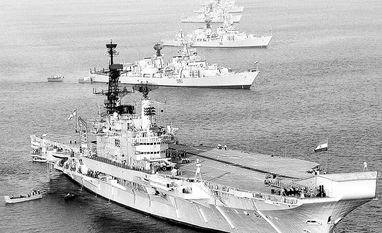
Indian naval ships in the Arabian Sea: A steady decline in maritime capability?
In the IOR too, despite reduced dependence on its energy resources, America has and will continue to have a military presence which will outmatch all others. As for China, leave aside its assertive positions in the East and South China Seas, we can expect to see a more proactive IOR stance and naval deployments and initiatives commensurate with it are already being seen in the frequent presence of its nuclear submarines and building of naval facilities at Gwadar and Djibouti.
Japan, a not insignificant military power in its own right, also has naval facilities and with its dependence on Gulf energy, must be reckoned as an important Indo-Pacific player. It has recently commissioned the second of two versatile helicopter carriers, each larger than our own INS Vikramaditya, even as it operates two relatively smaller platforms for the same purpose.
Then there are others which are either geographically “two-ocean” nations such as Australia, or sit astride the three vital chokepoints that connect the “Indo” part with the Pacific — Indonesia, Singapore and Malaysia. The fact that one of the vital shipping routes of the world runs across the stretch only adds to global concerns.
India’s responses to the developing situation need to be analysed at two levels. American interests and its presence in the region are positive to India’s concerns. The US sees India as a major IOR littoral power which can and should act as a “net security provider”, be it for ensuring the safety of commons or providing relief during natural disasters such as tsunamis and other assistance; its presence is not detrimental to our interests. Much the same can be said of Japan, which has serious dependencies on Gulf oil and with which we can act in tandem.
China, however, falls in a different category. While its participation in anti-piracy operations in the Gulf region starting 2008 was not an issue, Chinese moves in setting up naval facilities at Gwadar and at Djibouti must arouse concern — the first given its close linkages with Pakistan, and the second because they will enable extended deployment of naval forces. Its assertive postures in the South China Sea may well be replicated in some way in the IOR.
The second issue is that of our own naval capabilities. Without elaborating on them, it can safely be said that these have been allowed to get degraded considerably in the last decade when, in fact, they should have been enhanced. The navy’s share in the already dismal defence budget (lowest in several decades at 1.63 per cent of GDP) is simply not good enough to ensure that our maritime capabilities will be able to cope with the increasing volatility. This is disturbing, as it is in the IOR that we enjoy intrinsic advantages over China. There is an urgent need to invest in platforms — air, surface and underwater — that will allow us to deploy and operate across the area of our interest as the major littoral power.
Forty per cent of our GDP comes from trade, of which 90 per cent moves across the Indo-Pacific sea routes, more than half of it through the Western Pacific. India is not a littoral of that region but has an interest in seeing that those waters permit safe and free movement of commerce in keeping with international laws. It must also help the smaller littorals in exploring their waters for oil and gas, as it is doing in Vietnam, and later in deep sea mining for minerals. All this can happen only if there is stability in the region, which China’s postures could quite easily affect.
Our policies must first synergise with those of other littorals of the Indo-Pacific which have similar interests, and concurrently lead to capabilities that can support them. It is not certain if this is happening. Even the defence cooperation mechanisms that we have with many of them are languishing for want of funds, leave aside our inability to provide any significant military hardware. The Chinese, on the other hand, are moving at full steam. It is time India weighs anchor.
The writer is a former Commander-in-Chief of the Eastern Naval Command. He has been a member of the National Security Advisory Board

 "India's 'Indo-Pacific' challenges")












 Connect with us on WhatsApp