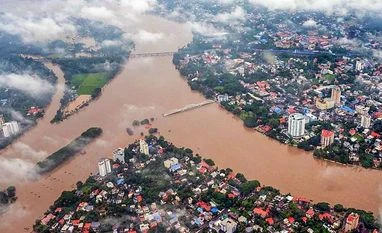
A year ago, flash floods created havoc in Kerala. As the nation responded to the disaster, an ugly truth emerged — that of fast changing patterns of rainfall in South Asia. As floods across the country rule the headlines again this year, a look at the last decade shows that rainfall variability has caused floods and water shortages across the country, including in the most unlikely of locations. There have been devastating floods in the deserts of Rajasthan and Ladakh, while rain-rich areas such as the North-East have faced water stress and lake-cities such as Chennai have run completely dry. A report by the United Nation’s Intergovernmental Panel on Climate Change predicts such changes are irreversible, and will continue to result in extreme weather conditions.
As a nation we pay attention to these phenomena only once they turn into disasters, taking lives and destroying property on a large scale. Nature is, however, making a case for drawing our attention to risks, which need to be addressed in advance, well before disasters strike. This calls for improved risk assessments, preventing investments in known hazard-prone zones, and building capacity to be able to take pre-emptive action.
Understanding nature’s wrath
Today, across the country, there are flood-and-drought-affected pockets next to one another. This is the new normal, and it will do us good to acknowledge and adjust to it quickly.
The impact of this new normal will also be worse than what we have ever seen, because besides the natural climate, our economic and social climate has also changed drastically over the last few decades. We have moved from living with nature, the way the homes of our grandparents reflected, to a far more affluent and arrogant lifestyle where we love to dare nature by constructing on the most hazard-prone lands, including hillslopes, riverbeds, lakebeds and seafronts. Whatever buffers we had in the form of natural vegetation that held slopes together and kept inundation in check, have also been lost to the new development pattern. While we revel in our successes on such development, nature does finally strike to reclaim these lands.
Furthermore, we continue to use 19th century models to respond to 21st century disasters. These methods follow an archaic system, where disasters are expected to follow a “season” and hit only in known geographies. Water released in dams, for example, is based on a manual system of measurement and prediction. Planning of our cities may be getting smarter from a technological point of view, but the fundamentals remain rooted in a narrow view of the economy, instead of expanding into an ecosystem-based perspective. All of these directly or indirectly contribute to the kind of disaster we are witnessing, which we then respond to with increasing bewilderment and enhanced focus on rescue and relief actions and investments.
All in all, we are still managing disasters, not risks. Given the conditions we now see all around us, both our preparedness and response need a serious revisit.
A future-proof response
The floods we have been witnessing have triggered an outpouring of support from all quarters, which is heart-warming . The onus is now on disaster managers to channel this into long-term investments for safety from future risks. Such investments may include greater engagement of local communities, improved hyper-local risk assessment, training on emergency response, crowdsourcing disaster-information and rebuilding devastated areas with local material and with respect for the environment.
Those living in vulnerable areas need the ability to assess their local risks better, and get access to accurate and easy to understand early warning. Notable disaster risk reduction efforts today are helping village communities in Bihar monitor their rivers and translate warning data into local actionable information; enabling tribal families in North Kerala figure out nature-based solutions to secure themselves against landslides; teaching school children in Uttarakhand how to assess and address risks within their school environments; and helping children in Sikkim operate a weather station and climate-lab within their school.
Long-term resilience in response to the new risks identified was missing from fundamental approach to disaster recovery. The job of the humanitarian world should be to provide resources and begin reconstruction in affected areas from day one, that is, to help faster recovery for affected families and build better and safer communities.
What our ancestors did right
One of the ways ahead is to understand how our previous generations had learnt to live with nature and risks. How land was selected for construction, water was harvested, courtyards kept houses well lit and ventilated, and at comfortable temperatures through the summers and winters. How nurturing native vegetation and wildlife around the houses and habitats kept things in balance. Recent experiences in Assam, Rajasthan, Ladakh and elsewhere have shown that reconstruction using local materials, traditional techniques and measured technological upgrades can lead to houses and settlements that are more environment-friendly and safe from future threats.
There are signs all around that we urgently need to shift our focus from rescue and relief to long term risk-management. Nature is sending us louder reminders each year. It is time to listen to nature and while doing so remind ourselves that our past holds the key to a safer future.
The writers are co-founders of SEEDS, a humanitarian organisation with a focus on building disaster-resilient and sustainable communities across Asia

 "Let's manage risks, not disasters")












 Connect with us on WhatsApp