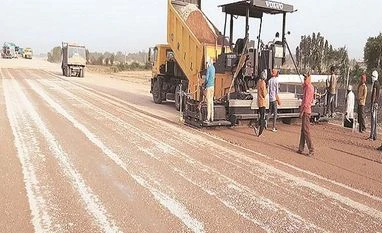
Work on the Purvanchal Expressway in progress. Infra projects, which the previous regime proposed and started, are incomplete for lack of funds, sloppy pace of work, or allegations of corruption. Photo: UPEIDA
Taking forward Prime Minister Narendra Modi’s Independence Day announcement on investing Rs 100 trillion in infrastructure, the government has put out a National Infrastructure Pipeline and is currently targeting investments worth Rs 102 trillion by 2024-25. On paper, the plan to increase investment in the infrastructure sector will not only directly help revive economic activity, which has slowed dramatically in recent quarters, but will also improve overall competitiveness and help sustain higher growth in the medium term. However, increasing investment to the targeted level will be challenging, and the government will need to create an enabling environment and constantly work to remove hurdles that have affected the sector over the years. Otherwise, the government’s latest initiative could end up being another example of putting the cart before the horse.
The first challenge, of course, will be of financing. According to the plan, the Central and state governments will have an equal share of 39 per cent in capital expenditure, while 22 per cent is expected to come from the private sector. The government finances are stressed, both at the Centre and states, and attaining projected fiscal targets is becoming increasingly difficult. Since the government cannot touch its obligations such as interest payment and salaries, invariably, it is the capital expenditure that gets affected. For example, in its latest annual study of state government finances, the Reserve Bank of India has highlighted the decline in the quality of spending. Differently put, higher revenue expenditure is affecting capital expenditure. The upcoming Union Budget will bring in more clarity in terms of the Central government’s ability to finance infrastructure projects. Also, the assumption of a significant increase in economic growth in the coming years would be tested. In the absence of a significant pickup in economic activity and tax revenues, the government will find it difficult to fund projects. Further, since infrastructure projects tend to have long gestation and given the state of the Indian financial system, financing could also be a challenge for the private sector.
Second, the coordination between the central and state governments would be critical. While the Centre and state governments have so far shown outstanding coordination in the context of goods and services tax, such an alignment is not the norm. The given political situation and the fact that the Bharatiya Janata Party has lost power in several states will only make things difficult for the Union government. Third, the government will need to initiate a series of reforms to be able to attract the desired level of investment by the private sector. The ability to enforce contracts, for instance, remains a big challenge, as highlighted in the World Bank’s ease of doing business rankings. It is also important to note that India needs a mechanism to ensure that state governments do not cancel contracts randomly because of the change of the guard at the political level. The government will also need to ease restrictions on acquiring land and hiring labour, and will need to avoid the mistakes of the past and design public-private partnerships (PPPs) more transparently. The recent experience of PPPs and foreign investment has been somewhat disappointing, and the sorry state of corporate balance sheets makes it doubtful whether the private sector can put up its projected share in infrastructure investment. There have been suggestions to set up 100 per cent government-owned special purpose vehicles (SPV) that secure all permissions, licences, and clearances, as well as undertake land acquisition. The SPV is then bid out to private developers. It’s an idea worth considering.
Read this article for free
Register to continue reading premium journalism and analysis from Business Standard.

 "Push for infrastructure")












 Connect with us on WhatsApp