Such centres, set up by the Container Corporation of India and the Railways, first came up in 2013. But the Varanasi project has been vested in political symbolism and electoral substance, considering that the Lok Sabha election is likely nine months away.
In 2014, Modi launched his Varanasi campaign from Raja Talab. Sunil Ojha, a former Gujarat legislator who minds Varanasi for the PM, explained: “The centre is a boon for farmers in and around the city because the cold storage will be powered 24X7 to ensure that the perishables remain fresh until they reach Mumbai. Farmers will be paid the Mumbai market price to ensure good returns for their produce.” Vegetable and fruit growers Ojha referred to are from the backward caste Shakhya, variously called Koeri, Kushwaha and Kachi. While the Shakhyas counted for little (although their numbers are significant in UP) during the previous regime, the Bharatiya Janata Party (BJP) integrated the less visible backward castes into a larger social template before 2014 to blunt the Yadavs’ clout.
The BJP is up against a formidable challenge posed by the prospective coalition of the Samajwadi Party, Bahujan Samaj Party and the Rashtriya Janata Dal (the Congress’s status is yet indistinct), which can potentially trim its tally of 73 (out of 80) Lok Sabha seats in the state. The strategy it pencilled in so far has three principal elements: Modi; “development”, urban and rural with a pronounced thrust on the latter; and fine-tuning the caste alliances that might collapse if the SP-BSP were together.
The plan has been executed in three phases: Galvanising the local cadre through the BJP’s classic themed “yatras”, the BJP president Amit Shah stepped in to pep up the cadre, whose heart was not fully in the Ambedkar Mission “padyatra”, conceived essentially to answer the Opposition’s “propaganda” of the BJP being “anti-Dalit”; or the “Jan Samwad Yatra”, launched to disseminate the Centre and the UP government’s welfare schemes and to oversee preparations in the booths. Lastly, Modi heralded his appearance at the opening of the world’s largest mobile factory in Noida on July 9 and will wrap up the month with a speech to the BJP’s mayors in Lucknow. “Modi will not utter the Hindutva word. For him it is development and the poor. Yogi Adityanath (the chief minister) will fill in on Hindutva,” a BJP source said.
Shah met the leaders and workers from all over UP in two meetings in July at Mirzapur and Agra, where his central message to the party’s malcontent — reportedly upset on being ordered to lay off “fixers” and not cultivate cronies — was: “We are not a party of contractors but of ideas and ideology.” UP BJP Spokesperson Chandra Mohan said: “Our cadre was told to focus on re-energising the booth committees and check the voters’ lists because the previous governments had fiddled around with them.” Bhupendra Yadav, the general secretary who was present in Mirzapur and Agra, said, “The booth committees must be socially inclusive.”
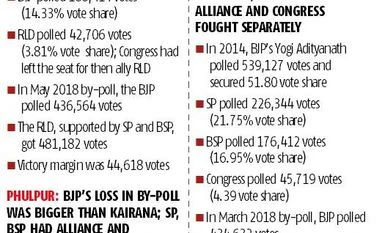
Sidharth Nath Singh, UP’s health minister and government spokesperson, said Shah’s prolonged interactions “instilled a sense of confidence” in the workers who felt shaken after the SP-BSP-RLD combine defeated the BJP in four recent by-elections. “The combine is a challenge but our organisational capacity is being strengthened again through programmes of mobilisation, the aggressive promotion of the MSP increase, and focus on Dalits,” said Singh.
The by-poll setback notwithstanding, UP Power Minister Shrikant Sharma said: “The only glue binding the Opposition is hatred towards Modi. Our answer is they are fighting to stop Modi’s development. The by-poll losses don’t matter because the atmosphere is different when voters elect a single MP and the country’s PM. Modi has his own vote.”
Sceptics contested the BJP’s optimism. A senior bureaucrat’s take was, “Only Hindu-Muslim polarisation can help the BJP... A solid counter consolidation of castes will weaken it. The BJP’s greatest advantages are the Opposition is without a face, is not working hard and lacks resources.”
One subscription. Two world-class reads.
Already subscribed? Log in
Subscribe to read the full story →
Smart Quarterly
₹900
3 Months
₹300/Month
Smart Essential
₹2,700
1 Year
₹225/Month
Super Saver
₹3,900
2 Years
₹162/Month
Renews automatically, cancel anytime
Here’s what’s included in our digital subscription plans
Exclusive premium stories online
Over 30 premium stories daily, handpicked by our editors


Complimentary Access to The New York Times
News, Games, Cooking, Audio, Wirecutter & The Athletic
Business Standard Epaper
Digital replica of our daily newspaper — with options to read, save, and share


Curated Newsletters
Insights on markets, finance, politics, tech, and more delivered to your inbox
Market Analysis & Investment Insights
In-depth market analysis & insights with access to The Smart Investor


Archives
Repository of articles and publications dating back to 1997
Ad-free Reading
Uninterrupted reading experience with no advertisements


Seamless Access Across All Devices
Access Business Standard across devices — mobile, tablet, or PC, via web or app
)