The Bharatiya Janata Party (BJP)’s main challenge in Delhi — bigger than winning the hearts of the city’s sizeable Dalit population or countering Arvind Kejriwal’s ‘disclosure a day’ against its leaders — is to bring its middle class support base to the polling booths on the day of voting on February 7.
Delhi’s youth and the middle class voted for the Aam Aadmi Party (AAP) in the 2013 Assembly elections, but were enamoured by Narendra Modi’s promise of development in the Lok Sabha elections. The BJP won all the seven seats in Delhi in the Lok Sabha, increasing its vote share from 33 per cent that it bagged in the 2013 Assembly to 46 per cent barely four months later in the Lok Sabha elections. That the middle class voted in greater numbers helped the AAP in 2013 Assembly and the BJP in 2014 Lok Sabha elections.
BJP strategists are confident the party will retain the youth and middle class votes it received in the Lok Sabha polls, but are unsure if these sections will queue to vote in what looks like a “no-wave” Assembly election. The voter turnout in 2013 was nearly 66 per cent (see box). The voting percentage of 65.07 in the Lok Sabha polls was the highest in 30 years. The all-time high being 71.31 per cent in the ‘wave’ elections of 1977.
The BJP and its ideological mentor, Rashtriya Swayamsevak Sangh (RSS), therefore, believe they need to work harder to ensure its youth and middle class support base turns up to vote. The BJP has made a list of 1,000 polling booths in Delhi’s urban seats, from the total 11,763 booths, which it lost to AAP by less than 500 votes in the 2013 Assembly polls. It has also focused on the seven seats it lost to AAP by less than 2,000 votes. Booth level workers have been asked to concentrate on ensuring people turn up to vote, similar to the RSS campaign of “100 per cent voting” in the 2014 Lok Sabha elections.
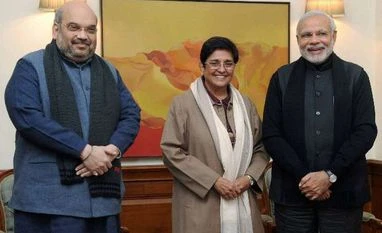
Some in the party believe announcing Kiran Bedi as its chief ministerial candidate at the earliest could enthuse the middle class to vote in large numbers. Posters and publicity material with Bedi as its “face” for the Delhi campaign are already being put up across Delhi. BJP leader Vijay Goel has come out in support of Bedi as the CM candidate. The party could announce Bedi as its CM candidate at the time of release of its list of candidates by early next week.
The party has strengthened its outreach to Dalits, which comprise nearly a fifth of Delhi’s electorate. BJP President Amit Shah on Friday addressed a ‘Dalit sammelan’ organised by the party’s Dalit MP from Delhi Udit Raj. The previous such gathering, a couple of months ago, had been a flop. Dalits, a traditional vote bank of the Congress, had moved to the AAP in the 2013 Assembly elections.
The BJP manifesto promises regular water supply, uninterrupted power, pucca houses to Delhi’s three million slum dwellers by 2022, regularising unauthorised colonies, which are home to four million of Delhi’s population, more schools and a multi-speciality hospital for some of Delhi’s outlying area. “We will focus on the 15 years of Congress misrule, and the mess the AAP left behind in its 49-day rule,” Shrikant Sharma, party national secretary, said.
The BJP, in its 2013 Assembly election manifesto, had promised to “continue to struggle for full statehood to Delhi”. It remains to be seen if it will reiterate that promise, now that there is a BJP-led government at the Centre.

 "BJP's Delhi challenge - getting youth and middle class to vote")

