Home / India News / CIC favours relook at declassification policy
CIC favours relook at declassification policy
A very clear trend should be more and more information coming out through more formal channels, says Vijai Sharma
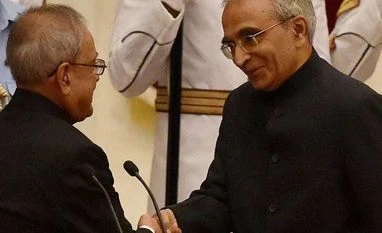
President Pranab Mukherjee exchanges greetings with newly sworn-in Chief Information Commissioner Vijai Sharma at Rashtrapati Bhavan in New Delhi. Photo: PTI
Amid the growing chorus for declassification of Netaji files, the new Chief Information Commissioner Vijai Sharma today said the policy in such matters needed to be revisited so that more information about historical events come from “formal channels”.
“Our past, much has been written (about it). A lot has been written and reliance has also been placed on whatever has been available, but if it is available through formal channels, then there is a certain quality which is missing if it is through other channels,” 64-year-old Sharma, a retired IAS officer, told PTI.
He was asked if information about mysterious disappearance of Netaji Subhas Chandra Bose and the controversy surrounding his reported death in a plane crash, a pre-independence occurrence, can be disclosed in bits and pieces, resulting in an incorrect picture being presented and reputations being sullied.
Sharma said, “A very clear trend should be more and more information coming out through more formal channels.” “If some sifting or filtering needs to be done then those with great minds and understanding and insight can get together and work it out. Because general knowledge is one thing but if it has certain underpinnings then its quality gets a little embossed,” he said.
A controversy had recently broken out following reports that Netaji’s family was kept under surveillance by the Intelligence Bureau for 20 years, much of it during the tenure of Jawaharlal Nehru.
“Sometimes you don’t need the barriers you find in formal documents. So a revisit is required,” he said stressing on the need for a relook at the declassification policy.
Sharma cited a case before him where he felt a 50-year-old correspondence between a Governor and the President of India can be disclosed despite objections from the Home Ministry.
The CIC said he had been telling public authorities that so much of information about global events that was considered very confidential and secret years ago, has been revealed.
“They have been revealed because of requirement of research and as the adage goes lessons of history..... you cannot get lesson in history, and getting a lesson is a good thing, until you have the information,” he said.

 "CIC favours relook at declassification policy")


 Connect with us on WhatsApp